










































Table Of Content
Who Is the Panchayat Secretary and What Are Their Legal Duties
The Panchayat Secretary is a government-appointed official responsible for the daily administrative functioning of the Gram Panchayat. This person acts as the link between villagers and higher authorities like the Block Development Office (BDO). Many villagers wrongly assume the Panchayat Secretary is an elected representative, but legally, they are a public servant accountable under government service rules.
The Panchayat Secretary’s duties are clearly defined under State Panchayati Raj Acts and official government guidelines. They are not allowed to take arbitrary decisions or delay work based on personal preference. Every action taken by them must be supported by records, registers, and written orders. Failure to follow these duties can legally attract complaints and disciplinary action.
Legal and official duties of a Panchayat Secretary include:
- Maintaining records of government schemes, beneficiaries, and fund utilization
- Issuing official certificates like residence, income, caste (where authorized)
- Assisting the Gram Panchayat in implementing welfare schemes
- Recording resolutions passed in Gram Sabha and Panchayat meetings
- Managing files related to MNREGA, PMAY, pensions, ration lists, etc.
One of the most important responsibilities of the Panchayat Secretary is record transparency. Villagers have the right to know how funds are spent, how beneficiary names are selected, and why applications are approved or rejected. The Panchayat Secretary cannot legally hide records, refuse
Ignored or delayed action by a Panchayat Secretary? RTIwala uses RTI to force accountability and written action—contact now.
📞 Call: +91-7999-50-6996
💬 WhatsApp: https://help.rti.link/
🌐 www.rtiwala.com
Common Complaints Against Panchayat Secretary Faced by Villagers
Across villages in India, complaints against Panchayat Secretaries follow a clear pattern. These are not rare issues; they are everyday problems faced by villagers while accessing basic government services. Most complaints arise due to lack of transparency, intentional delay, or misuse of authority.
The most common complaint is unnecessary delay. Villagers submit applications for schemes or certificates, but weeks or months pass without any response. When asked, the Panchayat Secretary often gives verbal excuses instead of written reasons. This delay is usually intentional and meant to pressure villagers.
Frequently reported complaints by villagers include:
- Delay in issuing certificates or forwarding applications
- Non-inclusion or wrongful exclusion of names in beneficiary lists
- Demand for bribe for routine Panchayat work
- Refusal to provide copies of records or registers
- Ignoring written complaints or applications
Another serious issue is manipulation of beneficiary lists. Eligible villagers are left out while ineligible names are added due to favoritism or corruption. When villagers question this, they are often told “list upar se aayi hai” without any proof. Legally, such lists must be supported by records and selection criteria.
Many villagers also face the problem of verbal threats or intimidation. Panchayat Secretaries sometimes warn people not to complain or threaten delays in future work. This behavior discourages villagers from asserting their rights and creates fear at the local level.
These problems continue mainly because villagers are unaware that:
- Panchayat Secretaries are not above the law
- Complaints can be escalated beyond the village level
- Written records are mandatory, not optional
How to File Complaint Against Panchayat Secretary (Step-by-Step)
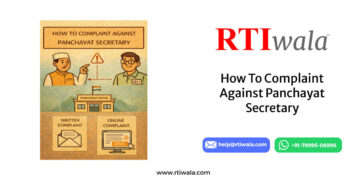
Filing a written complaint against a Panchayat Secretary is the most important step to create official accountability. Verbal complaints have no value in law. Only a written complaint creates a record and forces authorities to act. Many villagers fail at this stage because they don’t know the correct format or process.
A written complaint does not require a lawyer or complex language. It only needs clarity, facts, and proper submission. The complaint should always be factual, respectful, and supported by dates, documents, or events. Emotional or abusive language weakens your case.
Step-by-step process to file a written complaint:
- Write the complaint on plain paper or application format
- Mention your full name, address, mobile number, and village
- Clearly name the Panchayat Secretary and Gram Panchayat
- Describe the issue in simple words with dates and actions
- Clearly mention what service was denied, delayed, or misused
The complaint must focus on what went wrong, not assumptions. For example, instead of writing “he is corrupt,” write “my application dated ___ was not processed despite multiple visits.” Facts make the complaint strong and defensible.
Important points to remember while writing the complaint:
- Always mention dates of application and follow-ups
- Avoid emotional language or personal attacks
- Ask for written action or inquiry, not punishment directly
- Keep a photocopy of the complaint for your record
Once written, the complaint must be submitted properly. If submitting physically, insist on receiving a stamp, date, and signature on your copy. If sending by post, use registered post or speed post and keep the receipt. This proof becomes crucial if authorities later deny receiving your complaint.
Never submit only one complaint copy. Always prepare at least two copies—one for submission and one for your record. If possible, attach copies of any supporting documents like applications, receipts, or acknowledgments.
A properly filed written complaint changes the power balance. It moves the issue from “village talk” to an official administrative matter. Once on record, the Panchayat Secretary cannot legally ignore it without consequences.
Ignored or delayed action by a Panchayat Secretary? RTIwala uses RTI to force accountability and written action—contact now.
📞 Call: +91-7999-50-6996
💬 WhatsApp: https://help.rti.link/
🌐 www.rtiwala.com
Where to Complaint Against Panchayat Secretary (BDO, CEO Zila Panchayat, Collector)
Knowing where to complain is as important as knowing how to complain. Many villagers submit complaints to the wrong authority, which delays action. Panchayat Secretaries work under a clear administrative hierarchy, and complaints must move through that structure.
The first authority for most complaints is the Block Development Officer (BDO). The BDO directly supervises Panchayat Secretaries and has the power to seek explanations, conduct inquiries, and issue directions. Most service-related delays and misconduct complaints should start here.
Authorities where complaints can be filed include:
- Block Development Officer (BDO)
- Chief Executive Officer (CEO), Zila Panchayat
- District Collector / District Magistrate
If the issue is serious or the BDO does not respond, the complaint can be escalated to the CEO of the Zila Panchayat. This authority oversees Panchayat functioning at the district level and has stronger disciplinary powers. Escalation should always mention that the earlier complaint was ignored.
For cases involving corruption, misuse of funds, or repeated harassment, the District Collector becomes the appropriate authority. The Collector has overarching administrative control and can order inquiries, audits, or disciplinary action.
How to choose the correct authority:
- Service delay or non-cooperation → BDO
- Repeated negligence or list manipulation → CEO Zila Panchayat
- Corruption, threats, or abuse of power → District Collector
Complaints can be submitted in person, by post, or through official grievance portals where available. Regardless of the mode, the key requirement is proof of submission. Without proof, follow-up becomes impossible.
While escalating, always attach copies of previous complaints and acknowledgments. This shows a clear trail of negligence and strengthens your position. Authorities take escalation seriously only when earlier steps are documented.
Many villagers stop after one complaint due to fear or confusion. This is exactly why issues continue. The system is designed to respond when complaints move upward with evidence. Persistence with proper documentation is the real key.
Submitting a complaint to the correct authority turns a local issue into an administrative responsibility. Once higher officials are involved, Panchayat Secretaries usually respond quickly to avoid disciplinary trouble.
Ignored or delayed action by a Panchayat Secretary? RTIwala uses RTI to force accountability and written action—contact now.
📞 Call: +91-7999-50-6996
💬 WhatsApp: https://help.rti.link/
🌐 www.rtiwala.com
How to Use RTI to Take Action When No Complaint Is Heard
When a written complaint against the Panchayat Secretary is ignored, the Right to Information (RTI) becomes the most effective legal tool. RTI forces the Panchayat system to respond in writing and reveal official records. Unlike complaints, RTI cannot be ignored without consequences.
RTI works because it shifts the burden from the villager to the government office. Once an RTI is filed, the authority must reply within a fixed time limit. Even if the Panchayat Secretary refuses to cooperate, higher offices are legally bound to provide information available on record.
RTI should be used to ask questions based on documents, not opinions. The goal is to expose delays, misuse, or false claims through official records. This written evidence becomes powerful proof for further action.
RTI can be filed to seek information such as:
- Status of your application or complaint with dates
- Copies of beneficiary lists and selection criteria
- Fund allocation and utilization records of the Panchayat
- Duty registers, file movement details, and approvals
- Action taken reports on your written complaint
RTI applications should always be factual and specific. Avoid long explanations. Ask for certified copies or clear information available on record. For example, instead of asking “why was my work delayed,” ask “provide the date on which my application was received and processed.”
Key benefits of using RTI in Panchayat matters:
- Creates legally admissible written evidence
- Exposes false verbal claims made earlier
- Forces accountability through documentation
- Strengthens future complaints or legal action
RTI should ideally be filed with the Block or District office, not directly with the Panchayat Secretary, especially if they are the subject of the complaint. This prevents manipulation and ensures independent replies.
If no reply is received within the prescribed time, a First Appeal can be filed against the concerned Public Information Officer. This escalation often results in faster responses, as penalties may be imposed for non-compliance.
In many cases, once RTI replies are received, Panchayat officials resolve the issue immediately to avoid further scrutiny. RTI is not confrontation—it is a lawful demand for transparency.
What to Do If the Panchayat Secretary Threatens or Ignores You
Threats, intimidation, or deliberate ignoring by a Panchayat Secretary is a serious matter. Such behavior is not only unethical but also a violation of service conduct rules. Villagers often tolerate this due to fear, but the law provides clear protection when action is taken correctly.
The first rule is do not engage verbally after threats. Verbal arguments escalate situations and leave no proof. All communication should immediately shift to written mode. Written records protect the complainant and expose misuse of power.
Immediate steps to take if threatened or ignored:
- Stop verbal communication with the Panchayat Secretary
- Document dates, words used, and witnesses (if any)
- Submit a written complaint to higher authority
- Preserve copies of all applications and receipts
If the threat is serious, such as denial of services or intimidation for filing complaints, the issue should be escalated directly to the District-level authority. Mention clearly that the threat is in response to a lawful complaint or RTI filing.
RTI can also be used here to seek:
- Rules governing Panchayat Secretary conduct
- Action taken reports on complaints of harassment
- Transfer or disciplinary records (where applicable)
Many villagers fear retaliation, but written escalation actually reduces personal targeting. Once higher officials are involved, Panchayat Secretaries usually become cautious, as continued harassment can lead to suspension or departmental inquiry.
If the Panchayat Secretary completely ignores applications or refuses to accept documents, submissions should be made through registered post or official grievance channels. This ensures proof of delivery and prevents denial later.
Important precautions for villagers:
- Never withdraw complaints under pressure
- Avoid signing blank papers or verbal settlements
- Keep all interactions professional and documented
- Share copies with family members for safety
In extreme cases involving continuous harassment, a complaint can also be made to vigilance or anti-corruption authorities with RTI-backed evidence. Such action is rare but effective when supported by records.
Silence and fear allow misconduct to continue. Written action backed by RTI shifts power back to the citizen. When used properly, the system responds—even at the village level.
Delay or ignored complaints by officials? RTIwala helps you file RTI to force written accountability and official action.
📞 Call: +91-7999-50-6996
💬 WhatsApp: https://cc.rti.link/wadp
🌐 www.rtiwala.com
Frequently Asked Questions (FAQs)
1. How can I complain against a Panchayat Secretary in India?
You can file a complaint against a Panchayat Secretary by submitting a written complaint to the Block Development Officer (BDO). If no action is taken, you may escalate it to the Zila Parishad CEO, District Collector, or through the state/CM grievance portal. Always keep acknowledgment proof.
2. What are valid reasons to complain against a Panchayat Secretary?
Valid reasons include corruption, bribe demand, delay in work, misuse of Panchayat funds, manipulation of beneficiary lists, refusal to accept applications, harassment, or lack of transparency. Any action that violates service rules or denies public services is complaint-worthy.
3. Can I complain online against a Panchayat Secretary?
Yes. Most states provide online grievance portals where you can lodge complaints against Panchayat officials. Online complaints generate a tracking number and create a digital record, which increases accountability and reduces chances of suppression.
4. What should I write in a complaint against a Panchayat Secretary?
Your complaint should clearly mention:
- Name/designation of the Panchayat Secretary
- Panchayat and block name
- Exact issue with dates
- What relief or action you are seeking
Avoid emotional language and stick to facts and records for faster action.
5. What if no action is taken on my Panchayat complaint?
If no action is taken within 15–30 days, you should file an RTI application asking what action was taken on your complaint, who examined it, and why it is pending. RTI forces officials to give written, accountable replies.
6. Can RTI be used against a Panchayat Secretary?
Yes. RTI can be filed to seek:
- Status of your complaint
- Records of Panchayat work
- Fund utilization details
- Beneficiary lists
- Inspection and audit reports
RTI is one of the most effective legal tools to expose delay, negligence, or corruption.
7. Is it risky to complain against a Panchayat Secretary?
No, if done properly. Filing written complaints and RTIs through official channels is legally protected. Avoid verbal arguments and always maintain documentary proof to safeguard yourself.
8. How long does it take to get action on a Panchayat complaint?
Timelines vary, but:
- Written complaints are usually examined within 15–30 days
- RTI replies must be given within 30 days
- Escalated complaints (Collector/CM portal) often move faster due to monitoring
9. Can a Panchayat Secretary be suspended or punished?
Yes. If allegations like corruption, fund misuse, or serious misconduct are proved through inquiry or records, disciplinary action such as show-cause notice, suspension, recovery, or departmental proceedings can be initiated.
10. How can RTIwala help in Panchayat Secretary complaints?
RTIwala helps citizens by:
- Drafting professionally worded complaints
- Filing RTI to get proof and records
- Assisting with First Appeal if RTI replies are incomplete
- Guiding step-by-step without exposing the complainant
📞 Call: +91-7999-50-6996
💬 WhatsApp: https://cc.rti.link/wadp
🌐 Visit: www.rtiwala.com