


























What Are Certified Copies Under RTI and Why Applicants Ask for Them
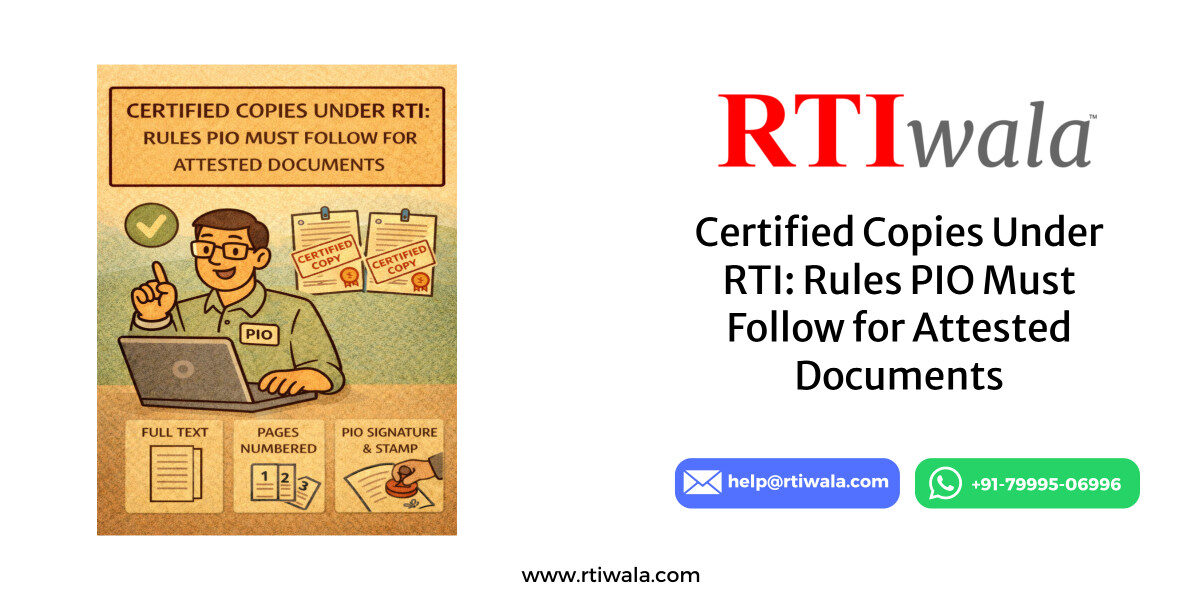
Certified copies under RTI mean officially attested photocopies of records held by a public authority, bearing the seal, signature, and verification of the Public Information Officer (PIO). These copies are not just papers; they are legally valid documents. Applicants usually ask for certified copies when they need proof that can stand before courts, vigilance bodies, or government offices.
Most RTI applicants search for certified copies because:
- Plain photocopies are often rejected by authorities
- Legal proceedings demand attested documents
- Complaints require documentary proof, not screenshots or scans
Certified copies confirm that:
- The document is genuine
- The information is sourced from official records
- The copy matches the original record exactly
In practical terms, people file RTI for certified copies to:
- Prove corruption, delay, or irregularities
- Support court cases or appeals
- Attach documents in complaints to CVC, Lokayukta, or departments
Many applicants face confusion because:
- RTI replies often include unstamped, unsigned pages
- PIOs send computer printouts without certification
- Authorities later deny accepting those copies as proof
This is why certified copies are not optional—they are essential when RTI is used as a legal or administrative tool.
Ignored complaint or missing reply? RTIwala helps file RTI to force official action and get written proof.
📞 Call: +91-7999-50-6996
💬 WhatsApp: https://cc.rti.link/wadp
🌐 www.rtiwala.com
Legal Rules PIO Must Follow While Issuing Attested Documents
Under the RTI framework, a PIO is legally bound to provide certified copies when an applicant specifically asks for them. This obligation is not discretionary. If records exist in material form, certification is mandatory. Failure to certify is treated as incomplete or defective information.
A valid certified copy must include:
- Official seal of the public authority
- Signature of the PIO or authorized officer
- Date of certification
- Clear endorsement stating “True Copy” or “Certified Copy”
PIOs cannot refuse certification by claiming:
- “RTI Act does not mention certification”
- “Soft copies are enough”
- “Office policy does not allow stamping”
Legally, the PIO must ensure:
- Copies are legible and complete
- All pages are certified, not just the first page
- Annexures, notes, and enclosures are included
If records are held digitally, the PIO must:
- Print the record
- Certify the printed version
- Not shift responsibility to the applicant
Common rule violations by PIOs include:
- Sending unsigned PDFs by email
- Attesting only one page of multi-page documents
- Writing “issued under RTI” without seal or signature
Difference Between Plain Copies and Certified Copies in RTI
A plain copy is a simple photocopy or printout of a document without any official verification. It carries no legal authenticity and can be denied by courts, departments, or inquiry bodies. Many RTI applicants receive plain copies unknowingly and later face rejection when using them officially.
A certified copy, on the other hand, is:
- Stamped with the department’s official seal
- Signed by the PIO or authorized officer
- Endorsed as a “True Copy” of records
The practical difference matters because:
- Plain copies are treated as informational only
- Certified copies are treated as official evidence
In real-world usage:
- Courts accept only certified copies
- Vigilance complaints require attested proof
- Departments demand certified documents for action
PIOs often send plain copies claiming:
- “RTI does not mandate certification”
- “You did not specify certified copy clearly”
However, once an applicant requests certified copies, plain copies become legally insufficient. Understanding this distinction protects applicants from unknowingly accepting unusable RTI replies.
Ignored complaint or missing reply? RTIwala helps file RTI to force official action and get written proof.
📞 Call: +91-7999-50-6996
💬 WhatsApp: https://cc.rti.link/wadp
🌐 www.rtiwala.com
Common Mistakes PIOs Make While Providing Certified Copies
PIOs frequently commit errors that render certified copies legally defective, even though documents are supplied. These mistakes are subtle but critical and are often used to dilute the impact of RTI disclosures.
The most common mistakes include:
- Certifying only the first page of multi-page documents
- Missing seal or missing signature
- No date mentioned on certification
Other frequent issues faced by applicants:
- Sending scanned PDFs without physical certification
- Writing “issued under RTI” without attestation
- Excluding annexures, notes, or file notings
Such mistakes cause serious problems because:
- Authorities later deny document validity
- Courts reject incomplete certification
- Appeals become harder without proper proof
PIOs may argue:
- “This is how we normally issue documents”
- “Office practice does not allow full certification”
These justifications have no legal standing. A certified copy must authenticate the entire document, not parts of it. Any missing element makes the response challengeable.
What to Do If PIO Refuses or Gives Uncertified Documents
If a PIO refuses to provide certified copies or sends uncertified documents, the applicant should not accept the response as final. Such replies amount to incomplete information, even if documents are attached.
Immediate steps an applicant should take:
- Preserve the RTI reply as evidence
- Note missing certification details clearly
- Avoid filing a fresh RTI for the same issue
The correct course of action is to:
- File a First Appeal citing defective supply
- Highlight lack of certification and legal non-compliance
- Request re-issue of properly attested copies
If refusal is verbal or implied:
- Ask for written clarification
- Use RTI reply itself to show non-compliance
In many cases, appellate authorities:
- Direct PIOs to reissue certified copies
- Record adverse remarks against the PIO
- Treat refusal as partial denial of information
Accepting uncertified documents silently can:
- Weaken future complaints or cases
- Give departments an escape route
- Close the opportunity for correction
Ignored complaint or missing reply? RTIwala helps file RTI to force official action and get written proof.
📞 Call: +91-7999-50-6996
💬 WhatsApp: https://cc.rti.link/wadp
🌐 www.rtiwala.com
How to Demand Proper Certified Copies Through RTI Appeal
When a PIO provides uncertified or improperly certified documents, the most effective legal remedy is filing a First Appeal. An appeal is not optional in such cases—it is the formal mechanism to correct defective information. Many applicants lose their case strength simply because they do not escalate at the right time.
While drafting the appeal, the applicant must clearly state:
- Certified copies were specifically requested
- Documents supplied lack seal, signature, or full attestation
- Information provided is incomplete and unusable
The appeal should focus on deficiency in form, not quantity. Even if all pages are supplied, lack of certification amounts to non-compliance. Appellate authorities routinely accept this argument because certification goes to the root of authenticity.
Key points to assert in the appeal include:
- RTI information must be supplied in the form requested
- Certified copies are necessary for legal and official use
- Uncertified documents defeat the purpose of RTI
Applicants should also:
- Attach the original RTI application
- Attach the defective RTI reply
- Highlight exactly what is missing
In many cases, appellate authorities issue directions such as:
- Re-issue certified copies within a fixed timeline
- Certify every page including annexures
- Ensure seal and signature on all documents
If the PIO still fails to comply, the appeal record becomes strong evidence for:
- Second Appeal
- Penalty proceedings
- Disciplinary recommendations
Demanding certified copies through appeal is not confrontation—it is asserting a legal right and ensuring RTI delivers enforceable outcomes.
How Certified Copies Help in Court, Complaints, and Official Use
Certified copies obtained through RTI are powerful because they carry official authenticity. Unlike downloaded data or unsigned printouts, these documents are presumed to be correct and sourced from government records. This presumption gives them legal weight.
In court proceedings, certified RTI copies are used to:
- Support writ petitions
- Challenge administrative actions
- Prove existence or absence of records
Courts rely on certified copies because:
- They bind the department to the disclosed facts
- Departments cannot later deny their own records
- The burden shifts to the authority, not the citizen
In complaints to vigilance or oversight bodies, certified copies:
- Establish documentary proof
- Prevent dismissal for lack of evidence
- Strengthen allegations of misconduct or delay
For official and administrative use, certified copies help in:
- Departmental representations
- Service matters and promotions
- RTI-based follow-up actions
Many authorities explicitly reject:
- Screenshots
- Email printouts
- Uncertified RTI replies
Certified copies eliminate excuses such as:
- “This document is not authenticated”
- “Source is not verified”
- “Record cannot be relied upon”
Practically, certified copies turn RTI from:
- A mere information tool
- Into an accountability and enforcement instrument
Applicants who understand this use RTI strategically, ensuring that every disclosure can stand scrutiny anywhere it is produced. This is why insisting on proper certification is not technical—it is essential for results.
Ignored complaint or missing reply? RTIwala helps file RTI to force official action and get written proof.
📞 Call: +91-7999-50-6996
💬 WhatsApp: https://cc.rti.link/wadp
🌐 www.rtiwala.com
Frequently Asked Questions (FAQs)
1. What is a certified copy under RTI?
A certified copy under RTI is an officially attested photocopy of a record, bearing the PIO’s signature, seal, and date, making it legally valid.
2. Is the PIO legally bound to give certified copies if asked in RTI?
Yes. If certified copies are specifically requested, the PIO must provide properly attested documents. Supplying plain copies amounts to incomplete information.
3. Are plain photocopies given under RTI legally valid?
No. Plain photocopies or unsigned printouts have no evidentiary value and are often rejected by courts, departments, and vigilance authorities.
4. What should a valid certified copy include?
A valid certified copy must include the department seal, PIO’s signature, certification endorsement (true copy), date, and attestation on all pages.
5. Can a PIO refuse certification citing office practice or policy?
No. Internal office practices cannot override RTI obligations. Certification is mandatory when requested, regardless of internal policies.
6. What should I do if the PIO gives uncertified or partially certified documents?
You should file a First Appeal citing defective supply of information and demand re-issuance of fully certified copies within a fixed timeframe.
7. Can certified RTI copies be used in court cases and complaints?
Yes. Certified RTI copies are admissible in courts and valid for complaints to vigilance, Lokayukta, and departmental authorities.
8. Does certification apply to annexures and file notings as well?
Yes. Certification must cover all pages, including annexures, notes, and enclosures. Partial certification is legally defective.