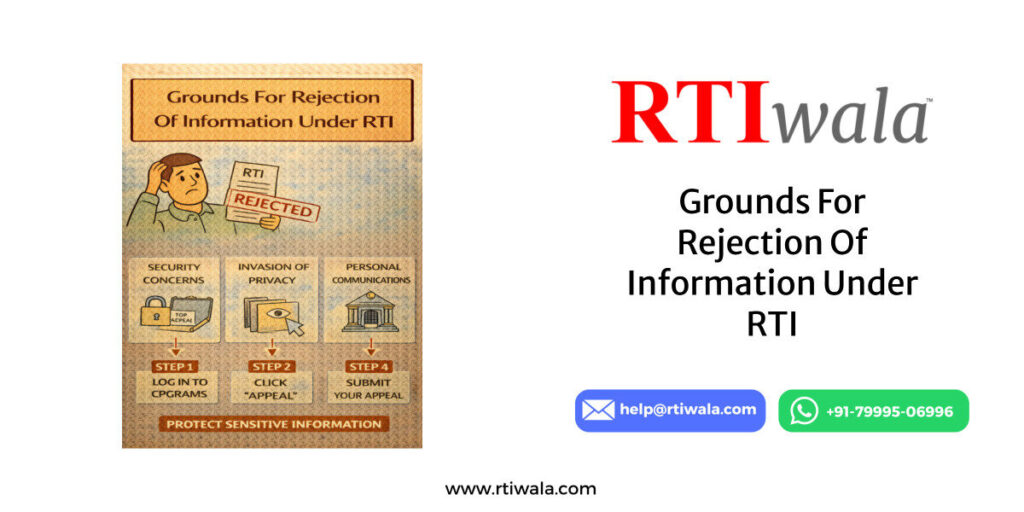





























What Are the Legal Grounds for Rejection of Information Under RTI Act
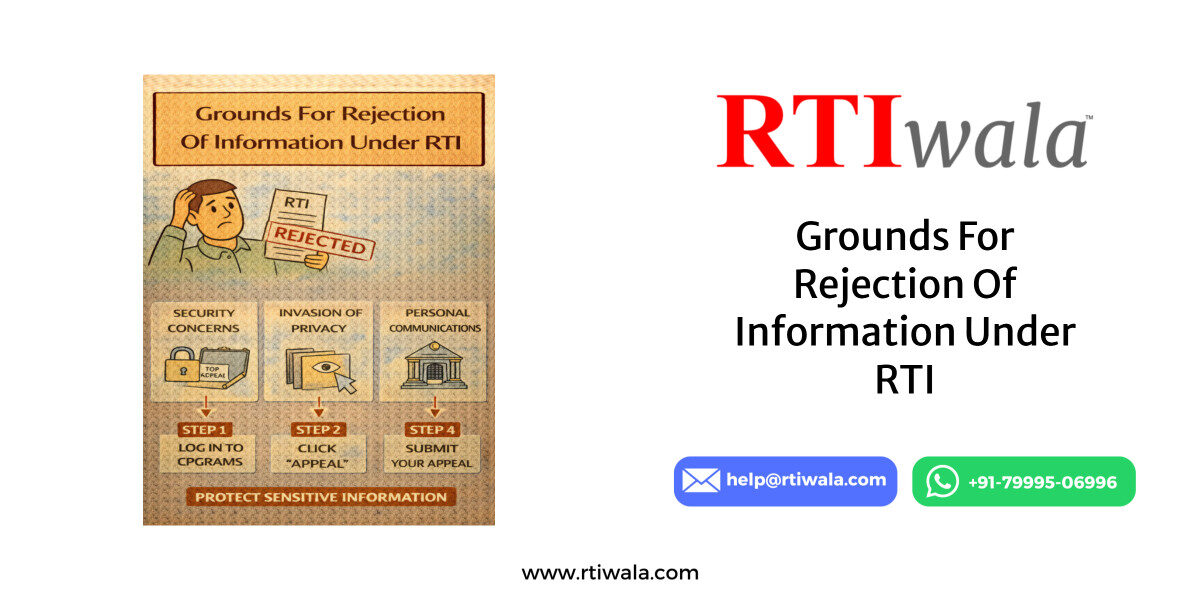
Many RTI applicants face rejection without understanding whether the denial is legally valid or arbitrary. The Right to Information Act allows rejection only on specific, clearly defined legal grounds. Any rejection outside these grounds is unlawful and challengeable.
Under the RTI Act, information cannot be denied simply because it is inconvenient, sensitive, old, or exposes wrongdoing. Rejection is permitted only when disclosure falls under explicit exemptions provided by law. If a Public Information Officer (PIO) rejects your RTI, they must clearly mention the exact legal provision used for denial.
Legally valid rejection must:
- Be backed by a specific section of the RTI Act
- Be explained in written form
- Show clear reasoning, not vague statements
- Be issued within the prescribed time limit
If your RTI reply says “information cannot be provided as per rules” or “not permissible”, without citing a section, it is not a valid rejection under law.
Most applicants lose cases because they assume rejection equals legality. In reality, many rejections are procedurally defective and collapse at the appeal stage.
Section 8 RTI Exemptions: When Information Can Be Lawfully Denied
Section 8 of the RTI Act is the most commonly misused provision to reject information. While it does allow denial, it applies only in specific and limited situations, not as a blanket excuse.
Section 8 exemptions exist to protect:
- National security and sovereignty
- Sensitive strategic or defense information
- Legitimate personal privacy
- Ongoing investigations where disclosure causes harm
However, Section 8 does not mean “no disclosure at all costs.” The law clearly states that information must still be provided if public interest outweighs the harm.
Common Section 8 clauses used for rejection include:
- Information affecting national security or foreign relations
- Information forbidden by courts or tribunals
- Information that would impede investigation or prosecution
- Personal information with no public interest involved
What applicants must understand is this:
PIOs are legally required to apply a “public interest test” before denying information under Section 8. If this test is not recorded or explained, the rejection is weak.
Another crucial safeguard is the severability rule. Even if part of the information is exempt, the non-exempt portion must still be disclosed. Total rejection when partial disclosure is possible is illegal.
Applicants should carefully read the reply and check:
- Is the exact Section 8 clause cited?
- Is there any public interest reasoning?
- Was partial disclosure considered?
If not, the rejection is vulnerable and can be overturned.
RTI rejected or wrongly denied? RTIwala helps identify illegal grounds and file strong appeals fast:-
📞 Call: +91-7999-50-6996
💬 WhatsApp: https://help.rti.link/
🌐 www.rtiwala.com
How Applicants Can Identify Misuse of Section 8 at First Glance
Most RTI rejections under Section 8 fail because they are mechanical, copied, or defensive. PIOs often rely on generic wording without applying the law properly.
Red flags indicating misuse include:
- No mention of which clause of Section 8
- Copy-paste language without case-specific reasoning
- No explanation of how disclosure causes harm
- No reference to public interest consideration
- Blanket denial of all points without segregation
The RTI Act places the burden of justification on the PIO, not the applicant. If reasons are missing or vague, the rejection does not meet legal standards.
Applicants should preserve such replies carefully. These defects become strong grounds in First Appeal and often lead to directions for disclosure.
Why Understanding Legal Grounds Is Critical Before Filing an Appeal
Many applicants rush into filing appeals without understanding why the RTI was rejected. This weakens the appeal and gives authorities an advantage.
Knowing the exact legal ground allows you to:
- Challenge the misapplication of law
- Demand public interest balancing
- Point out procedural violations
- Seek partial disclosure where possible
Appeals that clearly demonstrate misuse of Section 8 have a much higher success rate than emotional or generic appeals.
This is why experienced RTI handling focuses first on diagnosing the rejection, not blindly appealing.
Section 9 RTI Rejection: Copyrighted Information Explained Simply
Section 9 of the RTI Act is one of the most misunderstood and wrongly applied grounds for rejection. Many applicants are told that information cannot be provided because it is “copyrighted,” without proper explanation. This often discourages applicants unnecessarily.
Section 9 allows rejection only when providing a copy of information would infringe copyright held by a third party, excluding the government. It does not mean the information itself is secret or unavailable.
What Section 9 actually means in practice:
- Inspection of records cannot be denied
- Information can still be shared in non-copyright-infringing form
- Government-held documents are generally not protected from disclosure
- Copyright does not override RTI transparency
PIOs frequently misuse Section 9 to avoid providing:
- Tender documents
- Evaluation sheets
- Reports prepared by consultants
- Manuals, drawings, or formats
However, courts and Information Commissions have consistently held that:
- Inspection must be allowed
- Certified extracts can be provided
- Denial must explain how copyright is violated
- Blanket rejection is illegal
If a reply merely states “denied under Section 9 due to copyright” without explaining:
- Who owns the copyright
- How disclosure infringes it
- Why inspection is not possible
then the rejection is procedurally defective.
Applicants should remember:
RTI gives access to information, not ownership of copyright. Authorities cannot use Section 9 as a shield to hide records.
RTI rejected or wrongly denied? RTIwala helps identify illegal grounds and file strong appeals fast:-
📞 Call: +91-7999-50-6996
💬 WhatsApp: https://help.rti.link/
🌐 www.rtiwala.com
Common Wrong Reasons Used by PIOs to Reject RTI Applications
A large percentage of RTI rejections happen without any legal backing. These are not exemptions under the RTI Act, but excuses often used to reduce workload or avoid scrutiny.
Some of the most common illegal rejection reasons include:
- “Information is not available”
- “RTI is not the correct forum”
- “Query is hypothetical or advisory”
- “Applicant should visit the office”
- “Information is voluminous”
- “Records are old or not traceable”
None of the above reasons, by themselves, are valid grounds for rejection under the RTI Act.
Key legal realities applicants must know:
- If information once existed, it must be accounted for
- Volume of information is not a ground for denial
- RTI can seek records, not opinions — but records explaining decisions must exist
- PIO cannot force physical visits to deny RTI access
- Poor record management is not the applicant’s fault
PIOs are legally obligated to:
- Assist the applicant
- Provide available records
- Transfer RTI if held by another authority
- Give certified copies where applicable
When these duties are ignored, the rejection becomes illegal and appealable.
Most First Appeals succeed precisely because the original rejection relies on these non-statutory excuses.
Difference Between Valid RTI Rejection and Illegal Denial of Information
Understanding this difference is crucial. Not every rejection is illegal — but most illegal denials are disguised as valid rejections.
A valid RTI rejection will always:
- Cite a specific RTI Act section
- Explain why disclosure causes harm
- Apply the public interest test
- Offer partial disclosure if possible
- Be issued within statutory time limits
An illegal denial typically:
- Uses vague language
- Avoids legal section numbers
- Rejects all points together
- Ignores severability
- Shifts burden to applicant
- Lacks reasoning or evidence
The RTI Act places the burden of proof on the PIO, not the applicant. If the authority cannot justify denial clearly, the rejection cannot survive scrutiny.
This distinction is where most applicants lose confidence — and where appeals are actually won.
Applicants who clearly identify whether their rejection is:
- Law-based, or
- Convenience-based
are far more successful in challenging it.
What This Means for You Before Filing the First Appeal
Before moving forward:
- Read the rejection line by line
- Identify the exact legal section used
- Check if reasoning is explained
- Look for procedural lapses
- Preserve the reply carefully
A strong appeal is built not on anger, but on pinpointing legal failure.
RTI rejected or wrongly denied? RTIwala helps identify illegal grounds and file strong appeals fast:-
📞 Call: +91-7999-50-6996
💬 WhatsApp: https://help.rti.link/
🌐 www.rtiwala.com
What to Do If Your RTI Is Rejected on Wrong Grounds
An RTI rejection is not the end of the process. In many cases, it is the starting point for stronger legal accountability. The RTI Act is designed in a way that wrong rejection itself becomes evidence against the authority.
The first step after receiving a rejection is not panic, but verification. Carefully read the reply and check whether the rejection meets legal standards. Most wrongful rejections fail because they lack proper reasoning, section reference, or public interest analysis.
Immediate actions every applicant should take:
- Preserve the RTI reply and envelope/email
- Note the date of receipt (very important for timelines)
- Identify whether a specific RTI section is cited
- Check if reasons are detailed or vague
- See whether partial information could have been provided
If the reply uses unclear phrases like:
- “Information cannot be shared”
- “Not permissible under rules”
- “Confidential in nature”
without citing law, the rejection is legally weak.
Applicants should also check whether:
- The PIO replied within the statutory time limit
- All points were answered individually
- Transfer under Section 6(3) was avoided incorrectly
- Assistance under Section 5(3) was denied
Every procedural lapse strengthens your position in appeal. The RTI framework is document-driven, and even silence or delay works in the applicant’s favor.
How to Challenge RTI Rejection Through First Appeal and Beyond
The First Appeal is the most powerful and effective remedy under the RTI Act. A well-drafted First Appeal often succeeds without needing hearings or commissions.
A First Appeal should not repeat the RTI application. Instead, it must attack the rejection legally and procedurally.
A strong First Appeal focuses on:
- Wrong application of RTI exemptions
- Absence of public interest reasoning
- Violation of Section 7 reply obligations
- Non-application of severability
- Mechanical or non-speaking orders
- Failure to assist the applicant
Key legal principles to rely on:
- Burden of proof lies on the PIO
- Exemptions must be interpreted narrowly
- Transparency is the rule, secrecy is exception
- Public interest overrides exemptions
- Procedural violations invalidate rejection
The appeal should clearly request:
- Setting aside of the rejection
- Direction to provide information
- Consideration of partial disclosure
- Written and reasoned order
If the First Appeal fails or is ignored, the RTI Act provides further remedies through:
- Second Appeal before Information Commission
- Complaint proceedings for procedural violations
- Penalty proceedings in appropriate cases
However, most cases do not need to go beyond First Appeal if the rejection is properly challenged.
RTI rejected or wrongly denied? RTIwala helps identify illegal grounds and file strong appeals fast:-
📞 Call: +91-7999-50-6996
💬 WhatsApp: https://help.rti.link/
🌐 www.rtiwala.com
FAQs: Grounds for Rejection of Information Under RTI Act
1. What are the valid legal grounds for rejection of information under the RTI Act?
Information can be rejected only under specific provisions like Section 8 (exemptions) and Section 9 (copyright). Any rejection without citing a legal section is invalid.
2. Can a PIO reject my RTI without mentioning any section of the RTI Act?
No. A rejection is illegal if the PIO does not clearly mention the exact section and clause of the RTI Act with proper reasoning.
3. Is “information not available” a valid reason to reject an RTI application?
No. If information once existed or should exist as part of official records, the PIO must account for it. Poor record management is not a valid RTI rejection ground.
4. Can RTI information be denied due to copyright under Section 9?
Only copies can be restricted, not access. Inspection of records must be allowed, and blanket rejection under Section 9 is unlawful.
5. What should I do if my RTI is rejected on wrong or vague grounds?
You should file a First Appeal within 30 days, pointing out procedural lapses, misuse of exemptions, and absence of public interest reasoning.
6. Is public interest considered while rejecting information under RTI?
Yes. Even exempt information must be disclosed if larger public interest outweighs the harm. Ignoring this test makes the rejection legally weak.
7. Can I get partial information if some parts are exempt under RTI?
Yes. The RTI Act mandates severability, meaning non-exempt portions must be disclosed even if part of the information is denied.
8. Does RTI rejection mean my case is closed permanently?
No. Most RTI rejections are overturned at the First Appeal stage when challenged properly with legal reasoning.