







































What Is CRSORGI Birth Public Search and Why It Matters for Government Service Records
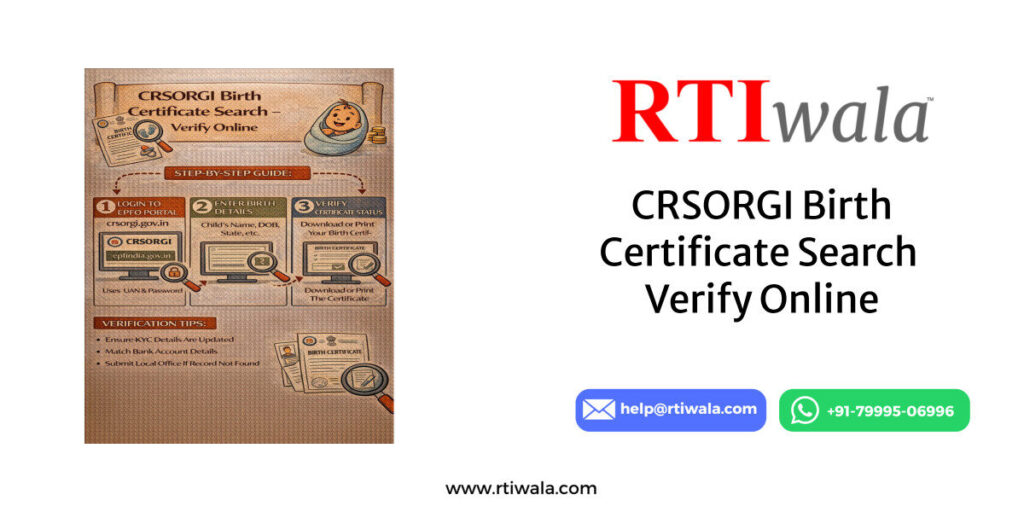
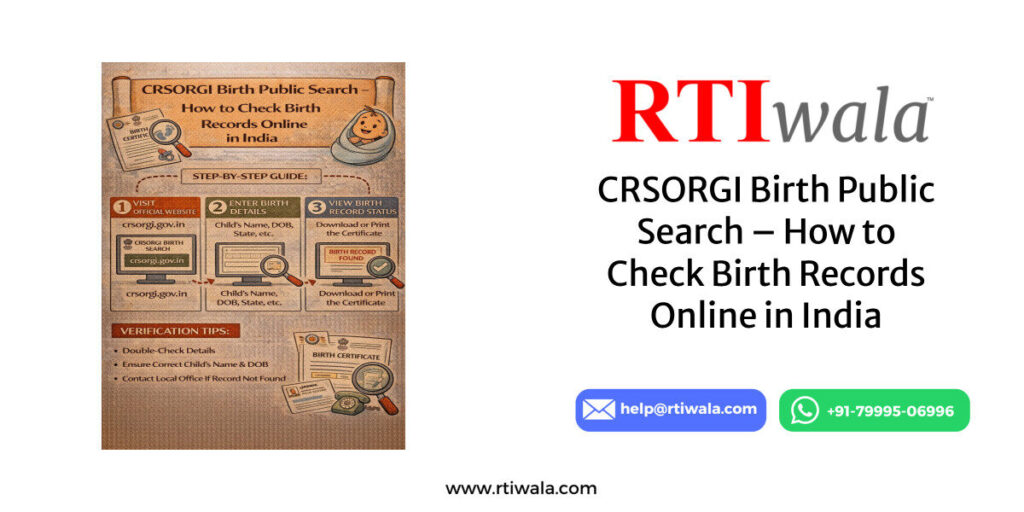
The CRSORGI Birth Public Search is an official online facility that allows citizens to search registered birth records maintained by the Civil Registration System (CRS) in India.
This system is operated under the authority of the Office of the Registrar General & Census Commissioner, India, making it a legally reliable source for date-of-birth verification.
For government employees, this portal plays a critical role because date of birth (DOB) is a foundational entry in service books, pension records, promotion eligibility, and retirement calculations.
Any discrepancy in DOB can directly impact service benefits and career timelines.
Why CRSORGI data holds high importance for service records:
- It reflects original birth registration data, not self-declared information.
- It is sourced from municipal, panchayat, or local registrar records.
- It is often treated as primary evidence during official verifications.
- Courts and departments rely on CRS data in DOB dispute cases.
Many government departments silently cross-verify service book DOB entries with CRS data during:
- Promotions and seniority checks
- Pension and retirement processing
- Vigilance or departmental inquiries
- Audit or compliance reviews
If a mismatch is detected later in service life, it can lead to sudden stoppage of benefits, forced corrections, or even disciplinary action.
That is why understanding and checking CRSORGI birth data early is not optional—it is preventive protection.
Common scenarios where CRSORGI becomes decisive:
- DOB entered incorrectly at the time of appointment
- Manual service book entries without birth certificate proof
- Legacy records created before digitization
- Clerical or typographical errors by departments
CRSORGI does not create new data—it only displays what was officially registered at birth.
This makes it extremely difficult to override without proper legal or administrative procedures.
How to Check Date of Birth of Government Employees via CRSORGI Portal
Checking a date of birth on the CRSORGI portal is a search-based process, not a correction mechanism.
The portal allows users to locate a birth record using minimal but accurate details related to birth registration.
To perform a successful search, accuracy of input matters more than speed.
Even minor spelling differences or wrong year selection can result in “No Record Found.”
Information typically required for search:
- State where birth was registered
- District or local body (municipality/panchayat)
- Year of birth registration
- Name of the person (as registered)
- Gender (in some states)
Once the correct combination is entered, the portal displays:
- Registered name
- Date of birth
- Place of birth registration
- Registration number (in many cases)
This displayed DOB is what departments treat as official CRS-backed data.
Important practical points users often miss:
- CRS year ≠ birth year in delayed registrations
- Name spelling follows local registrar records, not service book format
- Older records may exist only for specific year ranges depending on state digitization
If the DOB shown on CRSORGI matches the service book, it confirms record integrity.
If it does not match, it signals a high-risk compliance issue that should not be ignored.
Who usually needs this verification urgently:
- Employees nearing promotion or retirement
- Staff facing pension processing delays
- Officers under audit or vigilance review
- Employees whose birth certificates were never used at appointment
CRSORGI verification is often the first silent check done by departments before raising objections.
Employees who verify on their own gain time, control, and documentation advantage.
Ignoring this step can result in departments taking action without prior notice, especially when discrepancies surface during automated checks or third-party audits.
DOB mismatch in your government service records? RTIwala helps verify facts through RTI and protect your service benefits—contact now.
📞 Call: +91-7999-50-6996
💬 WhatsApp: https://help.rti.link/
🌐 www.rtiwala.com
Using CRSORGI Birth Data for Service Book & Employment Record Verification
CRSORGI birth data is increasingly used as a baseline verification source for government service records.
Departments rely on it because it reflects original, registrar-certified birth entries, not later declarations.
A service book is considered valid only when its core identity details—especially date of birth—match authoritative government records.
When doubts arise, CRSORGI data becomes the first point of comparison.
Where CRSORGI data is practically used in service verification:
- Initial appointment record audits
- Inter-departmental transfers
- Promotion eligibility scrutiny
- Pension and superannuation processing
- Vigilance or disciplinary inquiries
During verification, officials silently compare:
- Service book DOB
- Birth certificate copy (if submitted)
- CRSORGI public search result
If all three align, the record is treated as clean and compliant.
If CRSORGI differs, the service book entry is flagged—even if it has existed unchanged for decades.
Why CRSORGI carries higher evidentiary value:
- It is maintained under statutory registration rules
- Entries are created close to the time of birth
- It is independent of employment processes
- It cannot be altered through departmental orders
Many employees assume that a long-standing service book entry is final.
In reality, length of service does not override original birth registration data.
Common verification situations where CRSORGI is checked:
- Retirement date calculation
- Disputes over seniority or batch ranking
- Correction requests raised late in service
- Anonymous complaints triggering audits
Departments rarely inform employees before using CRSORGI data.
By the time a notice is issued, the verification process has usually already concluded internally.
This is why proactive CRSORGI verification is crucial—it allows employees to act before consequences begin.
Common Problems in Government Service Records Due to DOB Mismatch
Date of birth mismatch is one of the most damaging errors in government employment records.
Even a one-day or one-year difference can create serious administrative consequences.
These mismatches usually surface late, when correction options are limited.
Most common causes of DOB mismatch:
- Handwritten service book entries without proof
- Typographical errors at the time of appointment
- School records differing from birth registration
- Delayed birth registration showing a different year
- Regional spelling or calendar conversion errors
Once detected, departments treat DOB mismatch as a record integrity issue, not a clerical mistake.
Practical problems employees face due to mismatch:
- Promotion withheld or cancelled
- Pension file kept on hold
- Retirement date suddenly changed
- Vigilance clarification notices issued
- Forced acceptance of CRSORGI DOB
In many cases, employees are informed only after an adverse decision is prepared.
At that stage, the burden of proof shifts entirely onto the employee.
Why departments act strictly on DOB issues:
- DOB determines service length and financial liability
- Errors can trigger audit objections
- Courts have consistently prioritized birth records
- Late corrections are legally discouraged
A critical mistake employees make is assuming that:
- School certificates will override birth records
- Service book entries can always be corrected
- Departmental approval alone is sufficient
In reality, CRSORGI data often overrides all secondary documents.
High-risk situations for employees:
- Retirement within 5 years
- Applying for last promotion
- Undergoing departmental audit
- Facing anonymous complaints
Once a mismatch is officially recorded, options become limited to:
- Formal representations
- Documentary justification
- Legal or RTI-based verification
Ignoring the issue can lead to irreversible administrative decisions that directly affect career end benefits.
Early identification of DOB mismatch through CRSORGI gives employees a time advantage—time to understand records, collect proof, and respond strategically.
DOB mismatch in your government service records? RTIwala helps verify facts through RTI and protect your service benefits—contact now.
📞 Call: +91-7999-50-6996
💬 WhatsApp: https://help.rti.link/
🌐 www.rtiwala.com
What to Do If CRSORGI Birth Details Don’t Match Official Service Records
A mismatch between CRSORGI birth details and official service records is a serious administrative issue, not a minor clerical error.
Once detected, departments usually presume the CRSORGI record to be correct unless proven otherwise.
The first and most important step is not to rush into written acceptance or correction requests.
Any premature submission can permanently weaken the employee’s position.
Immediate actions an employee should take:
- Verify CRSORGI details multiple times for accuracy
- Check spelling, year of registration, and district selection
- Collect copies of all submitted documents at appointment
- Review original service book entry pages
Many mismatches occur due to delayed birth registrations or incorrect service book transcription.
Understanding why the mismatch exists is critical before responding.
Do not assume the department will guide you correctly.
Departments focus on compliance and audit safety—not employee interest.
Common mistakes employees make at this stage:
- Accepting CRSORGI DOB without verification
- Submitting self-written explanations
- Relying only on school certificates
- Approaching courts without document clarity
If a notice or query is already issued, the response must be:
- Fact-based
- Document-supported
- Procedurally correct
Any informal or emotional explanation usually works against the employee.
When mismatch is discovered late in service:
- Departments rarely allow corrections
- Burden of proof becomes very high
- Silence is treated as acceptance
- Retirement and pension dates may be revised
This is why controlled, documented, and strategic action is essential.
At this stage, external verification becomes more important than internal explanations.
How RTI Helps Get Correct and Verified Government Service Records
The Right to Information Act, 2005 provides a lawful and non-confrontational method to obtain verified government records related to service details.
RTI is not used to argue—it is used to extract facts on record.
Under the RTI framework governed by the Right to Information Act, 2005, an employee can legally access:
- Basis of DOB entry in service book
- Documents relied upon by department
- Internal verification reports
- Rules applied for DOB acceptance
- Action taken notes on mismatch
RTI shifts the situation from assumption to documented clarity.
How RTI practically helps in DOB mismatch cases:
- Reveals whether department verified CRS data earlier
- Confirms which document was treated as final proof
- Exposes procedural lapses or missing records
- Creates written evidence for future representation
Unlike representations, RTI responses are:
- Time-bound
- Officially signed
- Legally accountable
This makes them reliable for appeals, explanations, or legal review if required.
Key advantages of using RTI at this stage:
- No need to disclose intent or argument
- Cannot be ignored like informal letters
- Creates a permanent paper trail
- Prevents arbitrary departmental decisions
RTI is especially powerful when:
- Service book entries were made decades ago
- Birth certificates were never demanded
- Different departments hold conflicting records
- Employee faces retirement or pension delay
Without RTI-backed documents, employees are often forced to accept departmental conclusions without knowing their basis.
RTI does not correct records directly—but it provides the verified foundation required to respond correctly and safely.
DOB mismatch in your government service records? RTIwala helps verify facts through RTI and protect your service benefits—contact now.
📞 Call: +91-7999-50-6996
💬 WhatsApp: https://help.rti.link/
🌐 www.rtiwala.com
Frequently Asked Questions (FAQs)
1. What is CRSORGI Birth Public Search and is it legally valid for government service records?
CRSORGI Birth Public Search shows officially registered birth data maintained under India’s Civil Registration System and is treated as legally valid for service record verification.
2. Can CRSORGI birth records be used to verify a government employee’s date of birth?
Yes. Government departments use CRSORGI birth data to cross-verify date of birth entries in service books, pension files, and promotion records.
3. What happens if the date of birth in CRSORGI does not match the service book?
A mismatch can lead to service record objections, promotion delays, pension holds, or retirement date revision unless the discrepancy is properly examined and documented.
4. Can a government department change my service book DOB based only on CRSORGI data?
Departments may rely on CRSORGI data for verification, but any change in service records must follow documented procedures and applicable service rules.
5. Is a school certificate enough if CRSORGI birth data shows a different date of birth?
In most cases, school certificates are considered secondary documents and may not override original birth registration data shown in CRSORGI.
6. How can RTI help in resolving CRSORGI and service book DOB mismatch issues?
RTI helps obtain official records, verification reports, and documents relied upon by the department, giving clarity and evidence for safe and informed action.
7. When should a government employee check CRSORGI birth details?
Employees should verify CRSORGI birth data well before promotions, audits, or retirement to avoid last-minute disputes and administrative complications.