
































Table Of Content
How to Get Information from a Co-operative Society When Records Are Not Shared
Many members face the same issue — the society refuses to share audit reports, fund usage, maintenance bills, or election records.
Repeated verbal requests are ignored, emails go unanswered, and management says “internal matter.”
This creates suspicion about misuse of funds or lack of transparency.
In such cases, you need a legal and enforceable method, not follow-ups.
You should first try basic documented steps:
- Submit written request to Society Secretary/Chairman
- Ask for records under Society Bye-laws
- Keep email/letter proof
- Mention specific documents, not general questions
- Wait 7–15 days for reply
If they still deny or delay, RTI becomes the strongest legal tool.
RTI forces disclosure through the Registrar or government authority controlling the society, not the society directly.
This avoids arguments and makes officers legally accountable.
Simply put:
No response = move to RTI route immediately.
Society hiding records? RTIwala legally secures your co-operative society information fast — contact now
📞 Call: +91-7999-50-6996
💬 WhatsApp: https://help.rti.link/
🌐 www.rtiwala.com
Can You Legally File RTI Against a Co-operative Society? Eligibility & Rules Explained
This is the biggest confusion people have — “Can RTI be filed directly on a society?”
In most cases, NO, because co-operative societies are private bodies.
But there is an important legal solution.
You file RTI indirectly through the Registrar/Co-operative Department.
As per RTI Act:
- RTI applies to Public Authorities
- Registrar of Co-operative Societies (RCS) is a Public Authority
- RCS controls, audits, and regulates societies
- Therefore, records submitted to Registrar are accessible under RTI
This means you can legally obtain:
- Audit reports
- Inspection reports
- Complaint records
- Election approvals
- Financial filings
- Action taken reports
If the society has submitted documents to the Registrar, they must be disclosed under RTI.
Courts and CIC decisions have repeatedly supported this route.
So legally:
Don’t file RTI to Society
File RTI to Registrar/Assistant Registrar/Co-operative Department
This method works faster and is fully enforceable.
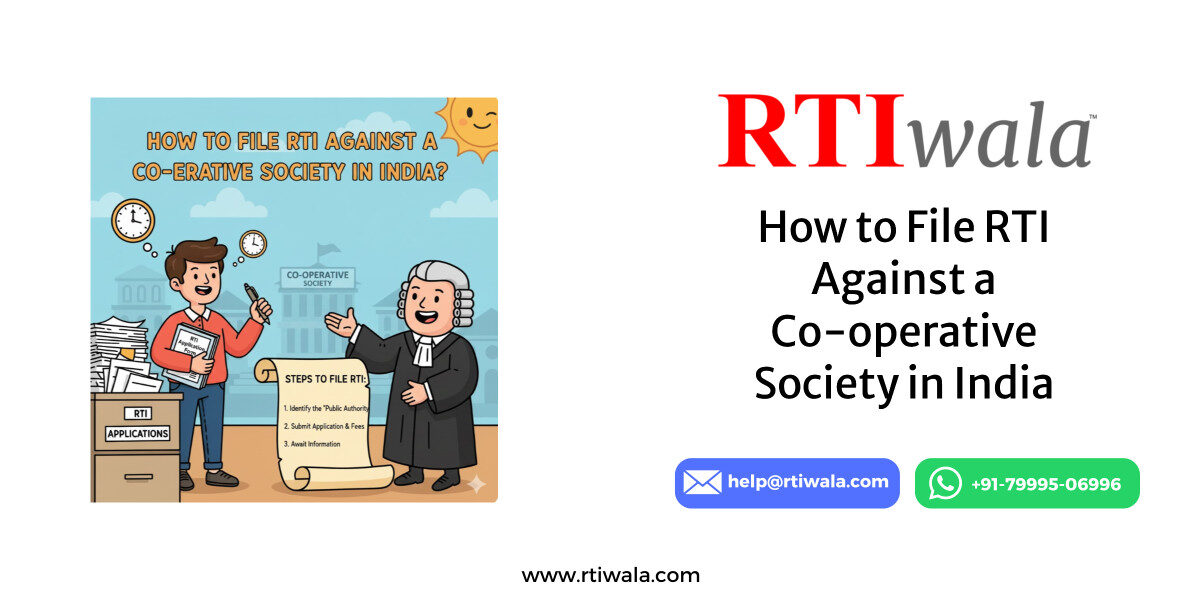
Step-by-Step Process to File RTI Online or Offline (Application Format + Where to Submit)
Once you know the correct authority, filing RTI is simple and systematic.
The goal is to ask for specific records, not complaints or explanations.
Clear questions increase approval chances and reduce rejection.
Always keep it document-based.
Step 1 – Identify Correct Authority
Find:
- Registrar of Co-operative Societies (State)
- District Assistant Registrar
- Co-operative Department Office
Search on:
“[State name] + Registrar Co-operative Society RTI PIO details”
Step 2 – Decide Filing Mode
You can file:
- Online RTI portal (if state supports)
- Speed Post
- Hand submission at office
Online is faster and trackable.
Offline is useful where portals are not available.
Step 3 – Draft Proper RTI Application
Keep questions short and record-based:
Ask for:
- Certified copies of audit reports
- Copies of inspection notes
- Maintenance fund statements
- List of complaints received
- Action taken reports
Avoid:
- “Why” questions
- Opinions
- Allegations
- Long stories
RTI works only for documents and records.
Step 4 – Pay RTI Fee
- Pay application fee
- IPO / Court fee stamp / Online payment
Attach payment proof.
Step 5 – Submit & Track
After filing:
- You get acknowledgment
- Reply must come within 30 days
- Delay = First Appeal right
Always save:
- Application copy
- Receipt
- Tracking ID
These are required if appeal is needed later.
Society hiding records? RTIwala legally secures your co-operative society information fast — contact now
📞 Call: +91-7999-50-6996
💬 WhatsApp: https://help.rti.link/
🌐 www.rtiwala.com
What Information You Can Ask: Audit Reports, Funds, Elections, Maintenance & Member Records
Most RTIs fail because people ask the wrong type of questions.
RTI is not for complaints or arguments — it is only for documents, copies, and official records.
If you ask correctly, approval chances become very high.
If you ask vaguely, it gets rejected.
Always remember:
Ask for “certified copies of records”, not explanations.
You can legally request the following through the Registrar or Co-operative Department:
- Annual audit reports
- Society balance sheet and income–expense statement
- Maintenance fund utilization details
- List of pending dues and defaulters
- Copies of inspection or inquiry reports
- Election records and approval letters
- List of managing committee members
- Copies of complaints filed against the society
- Action taken reports by Registrar
- Notices issued to the society
These records are already submitted to the department, so disclosure becomes mandatory.
Avoid asking:
- Why maintenance increased
- Why corruption happened
- Why election delayed
- Who is responsible
“Why” questions = rejection.
“Provide certified copy of record” = success.
Simple rule:
If it exists on paper/file, you can get it through RTI.
What to Do If RTI Is Rejected or No Reply: First Appeal, Registrar Complaint & Legal Remedies
Sometimes authorities delay or ignore replies.
This does not mean your RTI failed.
The RTI Act gives strong follow-up rights to citizens.
Most information is released during the appeal stage itself.
If no reply within 30 days or incomplete information:
Step 1 – File First Appeal
You must file within 30 days.
Include:
- Copy of original RTI
- Receipt/acknowledgment
- Mention “No reply received” or “Incomplete information”
- Ask FAA to direct PIO to provide full information
Submit to:
- First Appellate Authority (FAA) of same department
Reply time: 30–45 days.
In many cases, information is provided at this stage.
Step 2 – File Second Appeal (If Still Ignored)
If First Appeal fails:
- File Second Appeal to State Information Commission
- Attach all documents
- Mention delay or refusal
The Commission has power to:
- Order disclosure
- Penalize officer ₹250/day
- Impose departmental action
Officers usually respond quickly when penalty risk arises.
Step 3 – Additional Practical Remedies
If the issue is serious (fraud/misuse of funds), you can also:
- File complaint with Registrar of Co-operative Societies
- Seek special audit or inspection
- Use RTI documents as legal proof
- Approach consumer court or co-operative court if needed
RTI documents act as strong evidence, which makes further action easier.
So even if society denies verbally, once you have official records, the matter becomes legally strong.
Frequently Asked Questions (FAQs)
1. Can I file RTI directly against a co-operative housing society?
No, you usually cannot file RTI directly because most co-operative societies are private bodies.
Instead, file RTI with the Registrar of Co-operative Societies or Co-operative Department, as they are public authorities holding the society’s records.
2. Which authority should I send my RTI application to for society information?
Send your RTI to:
- Registrar of Co-operative Societies (RCS)
- Assistant/District Registrar
- State Co-operative Department PIO
These offices maintain audit reports, inspections, and official filings of societies.
3. What type of information can I legally obtain through RTI about my society?
You can request certified copies of:
- Audit reports
- Maintenance fund statements
- Financial records
- Inspection reports
- Election approvals
- Complaint and action taken reports
If the record exists with the department, it must be disclosed.
4. What questions should I avoid in RTI to prevent rejection?
Avoid asking:
- Why questions
- Personal opinions
- Explanations
- Allegations
RTI only provides documents and records, not justifications or reasoning.
5. How much is the RTI fee and how do I pay it?
The standard fee is ₹10.
You can pay via:
- Online payment portal
- Indian Postal Order (IPO)
- Court fee stamp
- Demand draft
BPL applicants do not need to pay the fee.
6. What if I don’t receive any reply within 30 days?
If there is no response within 30 days, file a First Appeal with the department’s Appellate Authority.
If still ignored, file a Second Appeal with the State Information Commission, which can penalize the officer.
7. Can RTI help expose misuse of maintenance or society funds?
Yes.
By obtaining audit reports, fund utilization statements, and inspection notes through RTI, you get official proof.
These documents can be used for complaints or legal action against mismanagement.
8. Can I file RTI online for co-operative society matters?
Yes, many states provide online RTI portals.
Search “[State name] online RTI portal” and submit digitally.
Online filing is faster and easier to track.