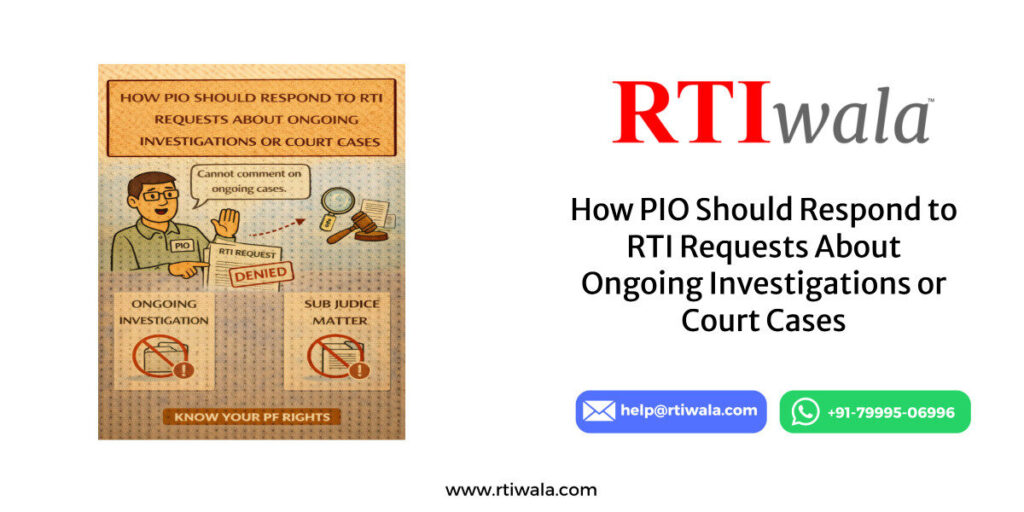




























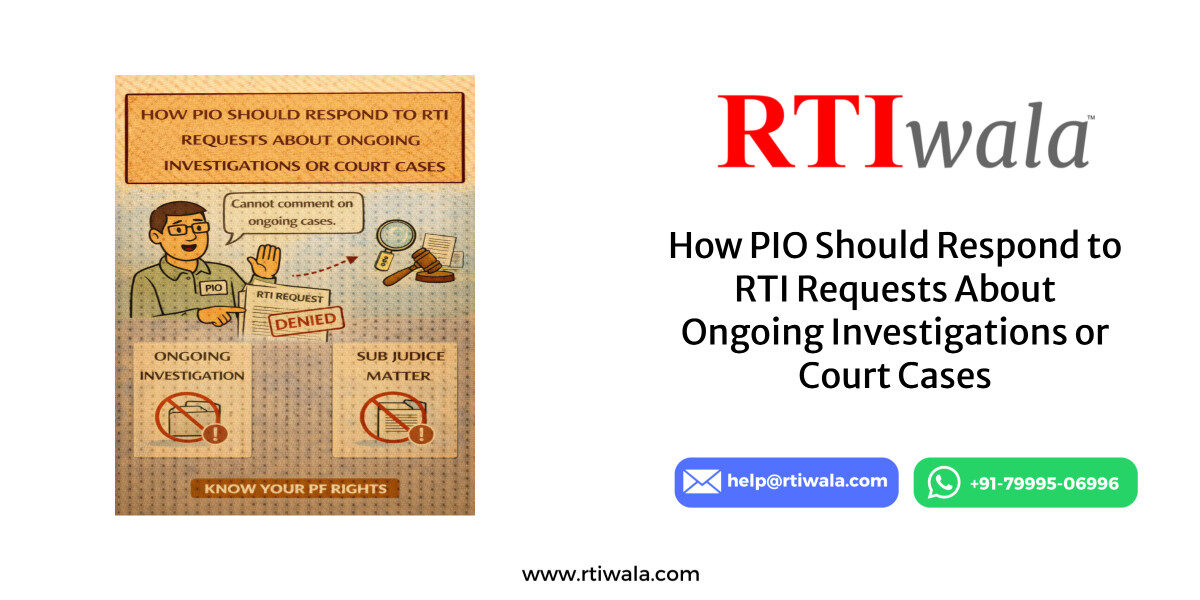
When an RTI application seeks information related to ongoing investigations or pending court cases (sub judice matters), the Public Information Officer (PIO) must respond carefully and strictly in accordance with the RTI Act, 2005. A pending investigation or court case is not, by itself, a valid reason to deny information.
Below is a clear legal framework on how a PIO should respond.
1. Pending Case Is Not a Blanket Exemption
The RTI Act does not prohibit disclosure merely because a matter is under investigation or pending before a court.
Incorrect response:
“Matter is sub judice; therefore, information cannot be provided.”
Correct approach:
The PIO must cite a specific exemption under Section 8 or 9 and justify its applicability.
2. Key Legal Provisions Applicable
Section 8(1)(h): Impeding Investigation or Prosecution
Information may be denied only if disclosure would impede the investigation, apprehension, or prosecution of offenders.
Proper use requires the PIO to:
- Explain how disclosure would obstruct the investigation
- Indicate the stage of the investigation
- Show a reasonable likelihood of harm
Improper use includes:
- Blanket denial without reasons
- Denial after investigation is complete
- Using the section for routine information like status updates
Courts and the CIC have clarified that the authority must demonstrate actual hindrance, not mere possibility.
Section 8(1)(b): Information Forbidden by Court
Information may be denied only if:
- A court has expressly prohibited disclosure, or
- Disclosure would constitute contempt of court
Valid denial example:
A court order specifically restricts disclosure of documents to third parties.
Invalid denial example:
Simply stating that the case is pending before a court.
Section 10: Severability (Partial Disclosure)
If only part of the information is exempt, the PIO must:
- Provide the non-exempt portions
- Redact sensitive parts
- Clearly mention the legal basis for redaction
Complete denial is not permitted when partial disclosure is possible.
3. Model Responses a PIO Should Give
Scenario A: Valid Denial Due to Ongoing Investigation
“The requested information pertains to an ongoing investigation. Disclosure at this stage may impede the investigation by revealing evidence collection methods and witness details. Therefore, exemption under Section 8(1)(h) of the RTI Act is invoked.”
This response is valid because it:
- Explains the harm
- Cites the correct section
- Provides reasoning
Scenario B: Case Pending in Court but No Prohibition
“The matter is pending before the Hon’ble Court. However, no court order prohibits disclosure. Accordingly, available records are enclosed.”
This is the legally correct approach.
Scenario C: Partial Disclosure
“Certain portions contain witness identities and are exempt under Section 8(1)(g). The remaining information is provided in accordance with Section 10 of the RTI Act.”
This demonstrates proper use of severability.
4. Common Errors by PIOs
- Rejecting RTI solely because the matter is sub judice
- Invoking Section 8(1)(h) without explaining how disclosure would impede investigation
- Denying entire records instead of providing partial disclosure
- Refusing information even after investigation is completed
Such responses are legally weak and can be challenged in appeal.
5. Information That Can Usually Be Disclosed
Unless specific harm is demonstrated, the following can often be shared:
- FIR copies
- Status of investigation
- Names and designations of investigating officers
- Dates of hearings
- File movement details
- Final reports after completion
Sensitive evidence, witness identities, or investigation strategies may be withheld if justified.
6. Grounds for First Appeal if Information Is Denied
An applicant can file a First Appeal if:
- No valid exemption is cited
- Reasons for denial are vague or missing
- Investigation is complete
- No court order prohibits disclosure
- Partial disclosure was not considered
7. Key Principle Established by CIC and Courts
- “Sub judice” is not a valid exemption under the RTI Act.
- Section 8(1)(h) requires specific justification.
- Transparency does not obstruct justice; unjustified secrecy does.