



































Understanding RERA Complaint Against Builder
1. What a RERA Complaint Means for a Homebuyer
A RERA complaint is a formal legal action a homebuyer files when a builder violates commitments related to possession, construction, money, or project delivery. It gives the buyer a direct way to hold the builder accountable without going through long court procedures. RERA examines your complaint, checks the evidence, questions the builder, and then issues a binding order. This makes the complaint a powerful tool for getting refund, interest, compensation, or timely possession.
A RERA complaint helps you get:
- Refund + Interest for delay
- Compensation for losses
- Strict action against the builder
- Clarification on project issues
- Legal enforcement if builder ignores commitments
RERA is designed to protect homebuyers quickly, fairly, and transparently.
2. When You Should File a Complaint Against a Builder
You should consider filing a RERA complaint the moment you notice the builder is not following the agreement or is delaying delivery without proper reason. Many users wait for months hoping the builder will respond, but RERA encourages early action because delays usually mean deeper financial or planning issues. If the builder has breached any written promise, demand, or legal requirement, you have a valid reason to file.
You should file a complaint if:
- Project is delayed beyond promised possession date
- Builder demands extra charges not in the agreement
- Layout or carpet area is changed without consent
- Construction quality is poor or unsafe
- Builder refuses to give OC/CC
- Builder makes false claims or provides misleading information
- Construction stops or project becomes inactive
RERA gives buyers a clear pathway to challenge any such violations.
Complaint against a builder stuck or moving slowly in RERA?
File an RTI through RTIwala to uncover file status, delays, and official accountability.
📞 Call: +91-7999-50-6996
💬 WhatsApp: https://help.rti.link/
🌐 www.rtiwala.com
3. Types of Issues That RERA Accepts
RERA accepts complaints related to delays, financial irregularities, construction issues, and all types of unfair trade practices by builders. The authority focuses on factual evidence and written commitments, not verbal promises. If you have documents showing the builder’s failure or misconduct, your case becomes immediately valid. RERA’s goal is to ensure developers follow the law while protecting buyers from losses and mental stress.
Common complaint categories:
- Possession Delay: Builder exceeds promised timeline
- Illegal Money Demand: Charges not mentioned in agreement
- Project Modification: Layout or amenities changed secretly
- Quality Defects: Leakage, cracks, poor materials
- Document Issues: No OC/CC, wrong plans, missing approvals
- False Advertising: Misleading brochures or claims
- Construction Halt: Work slowed or stopped without reason
If your issue belongs to any of these, RERA will hear your complaint.
Step-by-Step Guide to File a Complaint Against Builder in RERA
4. Step-by-Step Filing Process (Online & Offline)
Filing a RERA complaint is a simple process designed to let homebuyers take action without needing a lawyer. The authority ensures the system is transparent, allowing any buyer to submit their grievance directly. The online method is the most common, but almost every state also allows filing offline by visiting the RERA office. Following these steps carefully helps avoid delays and increases the chances of a quick resolution.
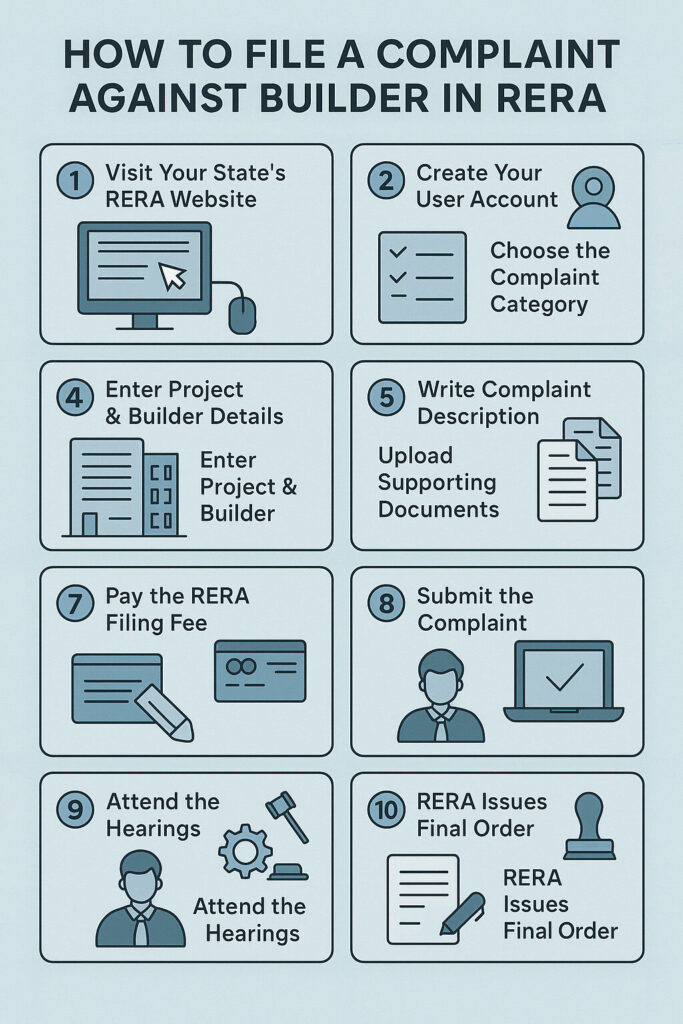
Step 1: Visit Your State’s RERA Website
Every state has its own RERA portal, and your complaint must be filed where the project is registered. This ensures it reaches the correct regional authority. Most portals offer a dedicated “Complaint Filing” section where users can start the process. Always confirm you are on the official government website to avoid fraud or unofficial platforms.
Example portals:
- MahaRERA: maharera.mahaonline.gov.in
- UP RERA: up-rera.in
- Karnataka RERA: rera.karnataka.gov.in
- Delhi RERA: rera.delhi.gov.in
Step 2: Create Your User Account (Complainant Profile)
To proceed, you must register an account using basic identity details. This helps RERA communicate hearing dates, notifications, or requests for additional documents. The registration form is simple and requires only standard information that verifies your identity and contact details for the case.
You must provide:
- Name and contact number
- Email ID (needed for updates)
- Address
- Aadhaar/PAN details
- Password for login
Step 3: Choose the Correct Complaint Category
Most RERA portals provide two filing categories, and selecting the right one ensures your complaint is processed correctly. The majority of buyers choose the general “Complaint to RERA Authority” option unless they are specifically seeking monetary compensation beyond refund or interest. This selection decides which officer will review your case and how the matter proceeds.
Options you will see:
- Complaint to RERA Authority (delay, wrong practices, irregularities)
- Complaint to Adjudicating Officer (compensation claims)
Step 4: Enter Project & Builder Details Accurately
This step identifies which project and builder the complaint is about. Providing accurate details ensures there is no confusion and helps the authority quickly locate the project’s registration file. These details also confirm whether the builder has met RERA registration requirements.
Information required includes:
- Project name and RERA registration number
- Builder/Developer name
- Project location and address
- Your unit number or booking details
Step 5: Write a Clear and Factual Complaint Description
This is the core section of your filing. The complaint must be written clearly, describing the issue you are facing and explaining how the builder has violated the agreement or RERA guidelines. Keeping the language factual avoids confusion and makes it easier for the authority to validate your statements during the hearing.
Your description should include:
- What the builder promised
- How the promise was violated
- Dates, timelines, and payment history
- Steps you already took to resolve the issue
- What relief you are requesting (refund, interest, possession, etc.)
Step 6: Upload All Relevant Supporting Documents
Documents are the backbone of your RERA complaint, because RERA decisions rely heavily on written proof. Make sure all uploads are clear, readable, and arranged in a logical sequence. You may upload multiple files to strengthen your case, even if some are optional. Strong documentation increases your chances of a favorable order.
Common documents to upload:
- Booking form / Allotment letter
- Builder-Buyer Agreement
- Payment receipts and bank statements
- Demand letters from the builder
- Email and WhatsApp communication
- Photos/videos of construction issues
- Copies of advertisements that misled you
Step 7: Pay the RERA Filing Fee
Once your form and documents are complete, the portal will ask you to pay a small complaint registration fee. The fee varies by state but is generally affordable. Payment confirms your complaint is formally registered and ready for review by the authority.
Typical fees:
- ₹1,000 to ₹5,000 depending on state rules
Payment methods often include: - Debit/Credit card
- Net banking
- UPI
Step 8: Submit the Complaint and Save Your Case Number
After successful payment, your complaint is officially filed, and a unique case/complaint number is generated. This number is extremely important because it is used to track your case status, view hearing dates, and receive updates from RERA. Keep this number safely as it acts as your case reference for the entire process.
You can track:
- Hearing schedule
- Case status
- Uploaded documents
- Builder’s response
Step 9: Attend the Hearings Scheduled by RERA
After reviewing your complaint, RERA will schedule one or more hearings to examine evidence from both sides. During the hearing, buyers usually present documents and explain the issue, while builders respond to allegations. The authority then evaluates the facts and asks for clarifications. Hearings can be offline or online depending on the state.
During hearings RERA will:
- Examine your documents
- Question the builder
- Validate agreement terms
- Review delay or violation details
- Take written submissions if needed
Step 10: RERA Issues a Legally Binding Final Order
Once hearings conclude, RERA passes a written order specifying what the builder must do. This order includes instructions, timelines, and penalties where applicable. The builder is legally required to comply with it. Non-compliance can lead to further enforcement actions such as recovery proceedings or asset attachment.
Final orders may direct builder to:
- Refund your full amount
- Pay interest for delay
- Provide compensation
- Complete construction by a deadline
- Deliver possession with documents
- Correct construction defects
Complaint against a builder stuck or moving slowly in RERA?
File an RTI through RTIwala to uncover file status, delays, and official accountability.
📞 Call: +91-7999-50-6996
💬 WhatsApp: https://help.rti.link/
🌐 www.rtiwala.com
5. Documents Required for a Strong RERA Complaint
A well-prepared complaint always includes solid documentary evidence to support each claim. RERA authorities rely on documents more than verbal statements because they provide clear proof of timelines, payments, commitments, and violations. Even if you do not have every document, submitting the essential ones is enough to initiate the case.
A. Identity Proof (Mandatory)
- Aadhaar
- PAN
Helps verify the complainant and maintain official records.
B. Booking & Agreement Documents
- Allotment letter
- Builder-Buyer Agreement
These establish your rights and the builder’s obligations.
C. Financial Proof of Payments
- Bank statements
- Payment receipts
- Builder demand notes
These show you have paid as per agreement.
D. Communication Records
- Emails
- WhatsApp chats
- Letters or notices
These help prove attempts made to contact or resolve the issue.
E. Construction or Quality Evidence
- Photos
- Videos
- Site reports
Helps RERA assess current project condition.
F. Marketing or Advertisement Claims
- Brochures
- Floor plans
- Screenshots of misleading ads
Useful when builder’s claims differ from reality.
RERA Timeline, Hearing Process, Orders & Penalties Against Builder
This part explains what happens after you file the RERA complaint, how long the process takes, what the hearings look like, and what actions RERA can legally take against your builder.
7. Timeline for RERA Complaint Resolution
RERA was created to provide fast and time-bound justice to homebuyers, unlike traditional courts which may take years. Although timelines vary state to state, most complaints follow a predictable pattern. Generally, initial scrutiny happens within a few weeks, and hearing dates are issued shortly after the complaint is accepted. Overall, buyers can expect the case to move faster than any other real estate dispute mechanism in India.
Typical RERA timeline:
- Scrutiny of your complaint: 1–3 weeks
- First hearing date: 30–45 days after filing
- Case arguments: 1–3 months
- Final order: Usually within 60–120 days
Some delays may occur if the builder asks for more time, but RERA tries to keep the process strict and time-bound.
8. What Happens During the RERA Hearing Process
The hearing is a crucial stage where both buyer and builder present their side before the authority. RERA ensures the environment remains simple, non-technical, and buyer-friendly so that even a consumer with no legal background can participate comfortably. The authority mainly reviews factual evidence such as agreements, receipts, commitments, and actual site conditions. This ensures the case is decided based on truth, not influence or pressure.
During the hearing, RERA will:
- Verify whether the builder violated commitments
- Ask both parties to present documents and responses
- Review written submissions for accuracy
- Question the builder on delays or false claims
- Allow the buyer to explain the impact of the violation
Hearings can be online (VC) or offline, depending on the state RERA rules.
9. What Orders RERA Can Pass Against the Builder
Once the authority has examined all evidence, RERA issues a legally binding order. This order states clearly what the builder must do and within what timeframe. These orders are enforceable, meaning builders cannot ignore or delay them without facing consequences. The type of order depends on the buyer’s request and the seriousness of the builder’s violation. In many cases, RERA sides with buyers because documentary proof clearly shows the builder’s failure.
RERA may pass orders such as:
- Full refund of amount paid by the buyer
- Refund with interest (often 8–12% range)
- Compensation for delay or mental harassment
- Mandatory completion of project within a deadline
- Deliver possession with interest for late handover
- Provide OC/CC if construction is complete
- Rectify poor construction quality
- Remove illegal charges or demands
Every order is written, published, and binding.
10. Penalties RERA Can Impose on the Builder
RERA has the authority to impose strong penalties on builders who violate rules or fail to follow its orders. These penalties are meant to protect buyers and ensure accountability in the real estate sector. Builders who habitually delay projects or mislead consumers are often fined heavily, and repeated violations can lead to criminal consequences. This legal power makes RERA one of the strongest regulatory bodies for homebuyers in India.
Possible penalties include:
- Heavy fines up to 10% of the project cost
- Daily penalties until compliance is achieved
- Freeze on project bank accounts
- Cancellation of project registration
- Debarment from future projects
- In extreme cases, up to 3 years imprisonment
These penalties push builders to take RERA cases very seriously and comply with orders quickly.
11. How RERA Delivers the Final Outcome
After evaluating all facts, RERA issues its final written judgment. This order clearly mentions the violation, the relief granted to the buyer, and the timeline for builder compliance. Once the order is issued, it becomes a part of official RERA records, and the builder is legally obligated to follow it. If the builder disagrees, they must file an appeal within a fixed time; otherwise, the order becomes final.
Final outcome usually includes:
- A written, enforceable RERA order
- Clear instructions to builder (refund, possession, compensation)
- A timeline for compliance (e.g., 30 or 60 days)
- Possible follow-up hearings if required
- Right to execution if builder does not comply
This ensures the buyer’s rights are protected until the issue is fully resolved.
What to Do If Builder Doesn’t Follow RERA Order, Execution Process, Appeals
This final part explains what happens after RERA passes the order, what you can do if the builder refuses to comply, and the legal enforcement steps available to the buyer. It also provides practical tips and answers to common questions so the user gets complete clarity.
12. What to Do If Builder Still Doesn’t Comply After RERA Order
Once RERA issues an order, the builder is legally required to follow it within the specified time. However, in some cases, builders delay payments, ignore deadlines, or try to negotiate again. If this happens, buyers should take immediate action rather than waiting. RERA gives homebuyers additional enforcement powers to make sure the order is implemented without unnecessary delay or pressure from the builder.
If builder doesn’t comply, you must:
- File an Execution Petition on the RERA portal
- Request RERA to initiate recovery proceedings
- Ask the authority to attach builder’s bank accounts or property
- File a complaint for non-compliance, which invites stronger penalties
Execution ensures the builder cannot escape the order.
13. Execution Petition – How It Works & Why It’s Powerful
An Execution Petition is similar to enforcing a court order. Once you file it, RERA acts like an enforcement authority and starts the process of recovering money or enforcing the order. The builder is given a short notice period to comply, failing which RERA directly initiates recovery actions. This step is extremely powerful because it forces builders to act quickly and prevents them from ignoring legal directions.
RERA may take enforcement actions like:
- Seizing builder assets
- Attaching bank accounts
- Issuing revenue recovery notices
- Asking district administration to intervene
- Ordering forced compliance within strict timelines
Most builders comply immediately once execution begins.
14. Appeal Process: What If Builder Challenges the Order?
Builders sometimes file an appeal to delay compliance, but this does not cancel the original order. To appeal, the builder must deposit a significant portion of the refund or amount owed, which discourages unnecessary appeals. Buyers, too, can appeal if they feel the relief granted was insufficient. Appeals are heard by the Real Estate Appellate Tribunal (REAT), which reviews the case again on legal grounds.
Important points about appeals:
- Builder cannot appeal without depositing part of the ordered amount
- Appeals must be filed within a fixed time (generally 60 days)
- Tribunal decisions are binding like RERA orders
- Further appeals go to the High Court
This ensures that buyers remain protected at every stage.
15. Buyer Tips to Strengthen Your RERA Case
Many buyers make avoidable mistakes such as not organizing documents, giving emotional statements, or missing deadlines. Instead, a buyer must approach the process in a structured and evidence-driven manner. RERA always gives more weight to clear documents than verbal claims. Following these tips increases your chances of a quick and favorable decision.
Helpful tips include:
- Keep all agreements and receipts in digital form
- Maintain a clean record of emails, messages, and promises
- Present facts clearly without exaggeration
- Always refer to timelines mentioned in the agreement
- Attend every hearing or arrange online presence
- Upload documents in good quality, readable format
A well-prepared buyer gets faster justice.
16. FAQs on Complaint Against Builder in RERA
These are the most practical questions homebuyers usually have when filing a complaint. Each answer is written simply so that anyone can understand the process without legal knowledge.
1. Can I file a RERA complaint without a lawyer?
Yes, RERA is designed for ordinary people. Anyone can file the complaint online without legal assistance. You just need the documents and basic details.
2. How long does RERA take to resolve a complaint?
Most cases are resolved within 60–120 days, depending on complexity and response time from the builder.
3. What if I want a refund instead of possession?
RERA allows full refund with interest if the builder delays possession or violates the agreement terms.
4. Can RERA force the builder to pay compensation?
Yes, RERA can order compensation for emotional distress, financial loss, or construction defects through the adjudicating officer.
5. What if the builder keeps delaying after the order?
You can file an execution petition, and RERA can attach builder assets or bank accounts to enforce payment.
6. Can I file RERA and consumer court case together?
Yes, but only for different types of relief. Most buyers first file RERA because it is faster and more effective.
7. Does RERA cover old projects?
RERA mainly covers projects that are ongoing or incomplete after the Act came into effect, but some states accept older cases depending on proof.