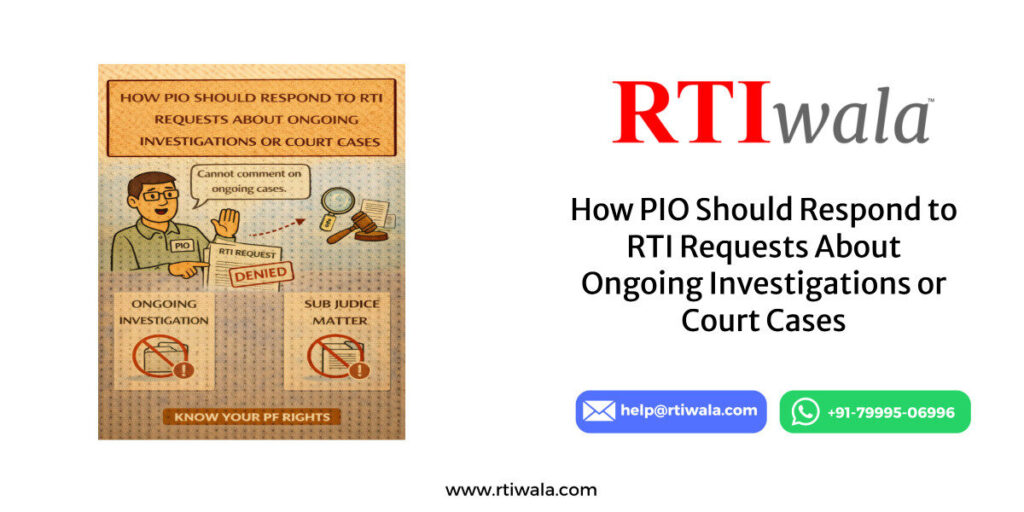




























Can Information Be Denied in RTI for Ongoing Investigation or Court Case?
This is the most misunderstood area of the RTI Act.
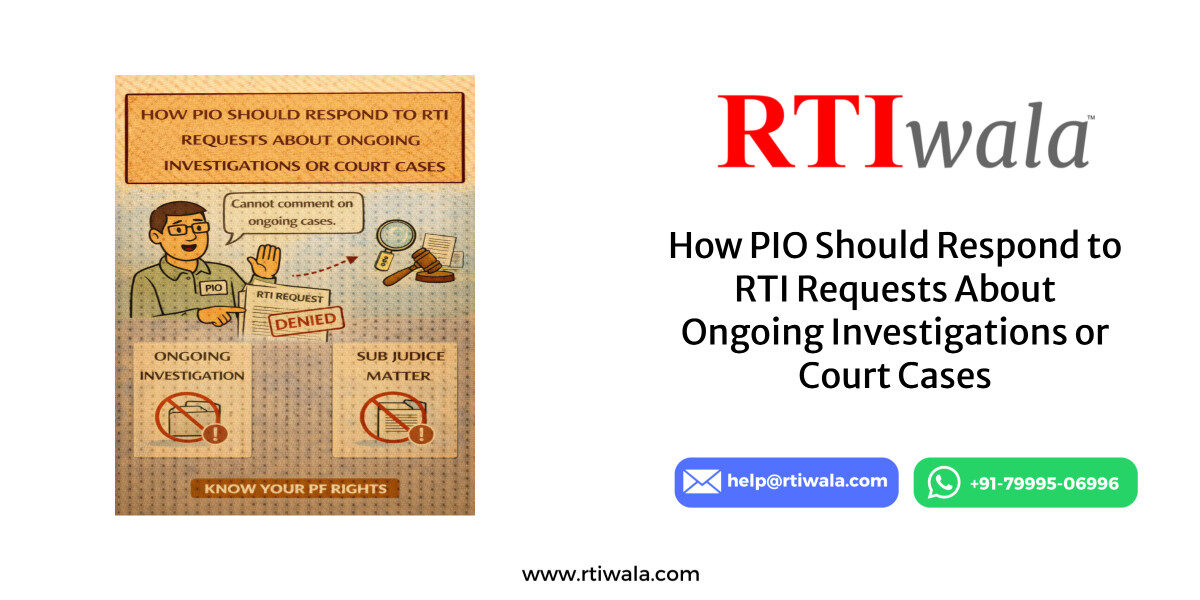
Many RTI applicants receive a straight rejection saying “case is under investigation” or “matter is sub judice”.
In reality, ongoing investigation or court case alone is NOT a valid ground to deny information.
The RTI Act does not provide blanket immunity to Public Information Officers (PIOs) just because a case is pending.
A PIO must apply legal tests, not assumptions.
Information can be denied only if disclosure causes specific, provable harm, not hypothetical risk.
PIOs are required to justify how disclosure will actually impede the process.
If no such impact exists, denial becomes illegal.
This is where most PIO replies fail and get overturned in appeals.
Key legal position:
- Pending investigation ≠ automatic exemption
- Pending court case ≠ automatic exemption
- Sub judice status ≠ RTI bar
What matters is the nature of information, not the status of the case.
From a citizen’s perspective, people usually seek:
- Status of investigation
- Copies of records already created
- File movement details
- Administrative actions taken
These categories are generally disclosable unless proven otherwise.
PIOs must understand that:
- RTI is about records, not opinions
- RTI does not interfere unless it actually obstructs justice
- Blanket denial invites penalty and adverse CIC remarks
Incorrect denial leads to:
- First Appeal allowed
- Second Appeal penalty risk
- CIC strictures on PIO conduct
Practical takeaway:
PIOs must stop using “ongoing investigation” as a shortcut.
Each RTI request needs reasoned application of law, not copy-paste replies.
Delay, no action, or ignored reply? RTIwala uses RTI to force official accountability and written proof.
📞 Call: +91-7999-50-6996
💬 WhatsApp: https://cc.rti.link/wadp
🌐 www.rtiwala.com
What RTI Act Sections Allow or Restrict Disclosure During Investigations?
Most confusion arises from wrong use or overuse of exemptions.
The RTI Act provides limited and conditional exemptions, not absolute powers.
PIOs must rely on specific sections, not general wording.
Courts and CIC consistently strike down vague replies.
The most commonly cited section is Section 8(1)(h).
This section allows withholding information only if disclosure would impede investigation, apprehension, or prosecution.
The word “impede” is critical and must be demonstrated with logic.
Section 8(1)(h) does NOT mean:
- Investigation is pending, so deny everything
- FIR is registered, so no information can be given
- Charge sheet not filed, so RTI is blocked
PIO must clearly explain how disclosure will impede the process.
Valid use of Section 8(1)(h) requires:
- Case-specific reasoning
- Clear nexus between information and obstruction
- Explanation in writing
Without this, denial is illegal.
Another misunderstood provision is Section 8(1)(b) related to contempt of court.
PIOs often claim “matter is sub judice” under this section.
This is legally incorrect unless the court has explicitly prohibited disclosure.
Section 8(1)(b) applies only when:
- A court order specifically bars disclosure
- Disclosure would amount to contempt
Simply being under trial does not qualify.
Important balancing provision: Section 10 (Severability).
Even if part of information is exempt, the rest must be disclosed.
PIOs are legally bound to:
- Black out sensitive portions
- Provide remaining records
Total denial without severability is a violation.
Also relevant is Section 4(1)(d) which mandates reasoned decisions.
PIO replies must be:
- Speaking orders
- Legally reasoned
- Section-specific
What lawful PIO replies must include:
- Exact RTI section invoked
- Logical explanation of harm
- Partial disclosure where possible
Failure to do this exposes the PIO to:
- Appeal reversals
- Penalty proceedings
- Adverse CIC observations
Practical takeaway:
PIOs must move from status-based denial to impact-based reasoning.
Applicants must check whether the cited section actually applies.
Delay, no action, or ignored reply? RTIwala uses RTI to force official accountability and written proof.
📞 Call: +91-7999-50-6996
💬 WhatsApp: https://cc.rti.link/wadp
🌐 www.rtiwala.com
How Should a PIO Legally Respond When Investigation Is Still Pending?
When an RTI request concerns a pending investigation or court case, the PIO’s reply must be careful, reasoned, and legally defensible.
A casual or generic response exposes the PIO to appeals and penalties.
The RTI Act expects the PIO to apply mind and law, not fear or convenience.
Every response must show that the PIO has examined the records individually.
The first step for a PIO is to identify the exact information requested.
PIOs should check whether the applicant is asking for:
- Existing documents
- Status updates
- File notings
- Administrative actions
RTI applies only to records that already exist.
If the record exists and disclosure does not cause real harm, it must be shared.
If the PIO believes exemption applies, the reply must be a speaking order.
A speaking order clearly explains why disclosure will cause harm, not just that it might.
The reply must avoid vague phrases like “may affect investigation” or “case is sensitive”.
Such language has no legal value in RTI proceedings.
A legally valid PIO reply must include:
- The exact section of RTI Act being invoked
- Clear reasoning linking disclosure to obstruction
- Why partial disclosure is not possible, if denied
PIOs must also consider partial disclosure seriously.
If only some portions are sensitive, those portions can be severed.
The remaining information must still be provided under Section 10.
Total denial without severability is considered a violation.
Time limits and format are equally important.
The reply must be:
- Given within statutory timelines
- Signed by the designated PIO
- Written in clear, understandable language
A well-drafted reply protects the PIO as much as it informs the applicant.
Poor drafting increases the risk of appeal, penalty, and reputational damage.
Practical takeaway:
PIO replies during pending investigations must be reasoned, section-based, and record-specific.
A lawful reply is always better than a defensive or evasive one.
When Is “Ongoing Investigation” Not a Valid Reason to Reject RTI?
One of the biggest RTI violations occurs when PIOs treat “ongoing investigation” as a magic shield.
Legally, this approach has been repeatedly rejected by Information Commissions.
The RTI Act does not allow denial based on status alone.
What matters is impact, not pendency.
“Ongoing investigation” is not a valid reason when:
- Information sought is administrative in nature
- Records were created before the investigation began
- Disclosure does not influence witnesses or evidence
For example, file movement records or sanction approvals usually do not impede investigation.
These are routine records and must be disclosed.
PIOs cannot deny them just because a related case exists.
Another common misuse is denial of status updates.
Providing the stage of investigation or procedural progress does not interfere with the process.
Applicants are entitled to know whether action is happening or stalled.
Lack of transparency here defeats the purpose of RTI.
Information already shared with:
- Courts
- Accused persons
- Other public authorities
cannot be denied under the excuse of secrecy.
Once information enters the public or judicial domain, withholding it under RTI becomes illogical.
PIOs also wrongly deny information citing possible future harm.
RTI law requires present, demonstrable obstruction, not speculative risks.
If the PIO cannot clearly show how disclosure will obstruct proceedings, denial fails.
Fear-based reasoning does not stand in appeals.
Another invalid ground is denial due to public criticism or media sensitivity.
RTI is not affected by embarrassment, exposure, or administrative discomfort.
The Act prioritizes transparency over convenience.
PIOs must separate legal risk from reputational anxiety.
Difference Between Information Affecting Investigation vs General Records
One of the most important distinctions under RTI law is between sensitive investigative material and general administrative records.
PIOs often mix these two and wrongly deny everything.
RTI law does not protect investigations as a whole; it protects only what truly needs protection.
Understanding this difference prevents illegal denials and appeal losses.
Information that may affect an investigation usually includes:
- Witness statements not yet tested
- Strategy documents or internal notes on prosecution
- Evidence analysis that could influence accused behaviour
Disclosure of such information may allow interference or manipulation.
Only in these limited situations can Section 8(1)(h) apply.
Even then, the PIO must explain the exact harm.
On the other hand, general records are normally disclosable.
These records do not influence the outcome of an investigation.
They reflect administrative functioning, not investigative strategy.
General records include:
- File movement and noting dates
- Sanction approvals or authority orders
- Correspondence between departments
- Status of action taken
These records already exist and are factual in nature.
Disclosing them does not help or hinder the accused.
Denying such information under “ongoing investigation” is legally flawed.
PIOs must apply a record-wise assessment, not a case-wise blanket approach.
Each document must be evaluated separately.
If a document does not directly obstruct investigation, it must be disclosed.
This approach is consistently upheld in RTI appeals.
For applicants, identifying this difference is critical.
Asking for records, dates, and actions instead of opinions improves success.
PIOs are legally weaker when denying neutral administrative data.
Practical takeaway:
RTI protects investigations, not opacity.
Only investigation-critical material can be withheld, not routine records.
Delay, no action, or ignored reply? RTIwala uses RTI to force official accountability and written proof.
📞 Call: +91-7999-50-6996
💬 WhatsApp: https://cc.rti.link/wadp
🌐 www.rtiwala.com
What CIC and Court Decisions Say About RTI in Pending Cases
Judicial interpretation plays a major role in RTI enforcement.
Both High Courts and the Central Information Commission have repeatedly clarified misuse of exemptions.
Their decisions strongly favour reasoned disclosure over blanket denial.
PIOs are expected to be aware of these principles.
Courts have consistently held that:
- Pendency of a case is not an RTI exemption
- “Sub judice” has no automatic RTI bar
- Exemptions must be narrowly interpreted
CIC orders frequently criticize PIOs for using stock phrases.
Replies lacking explanation are treated as violations of the RTI Act.
In many cases, CIC has directed disclosure despite ongoing investigations.
Another key principle from CIC rulings is burden of proof.
The PIO must prove why disclosure will impede proceedings.
The applicant does not have to prove innocence or public interest.
This shifts responsibility squarely onto the public authority.
Courts have also stressed partial disclosure obligations.
If part of a document is sensitive, only that part may be withheld.
Entire file denial is allowed only in rare, justified cases.
Failure to apply severability is treated as non-application of mind.
Judicial observations also highlight accountability.
PIOs acting mechanically face:
- Adverse remarks
- Directions for training
- Penalty proceedings
Good faith is not assumed when replies are careless or evasive.
For applicants, citing CIC logic in appeals strengthens their case.
For PIOs, following CIC reasoning reduces litigation and penalties.
Ignoring settled law is no longer defensible.
Practical takeaway:
CIC and courts demand logic, justification, and proportionality.
Any RTI denial in pending cases must survive judicial scrutiny.
What an RTI Applicant Can Do If PIO Wrongly Denies Information
Wrongful denial is common, but the RTI Act provides clear remedies.
Applicants should not stop at rejection letters.
Most illegal denials fail at the appeal stage.
The key is responding strategically, not emotionally.
The first step is filing a First Appeal within 30 days.
This appeal goes to a senior officer within the same public authority.
Applicants should focus on legal gaps in the PIO’s reply, not arguments.
Strong appeal points include:
- No section cited in denial
- No explanation of how disclosure impedes investigation
- Failure to consider partial disclosure
- Use of vague or generic language
If the First Appeal fails or is ignored, the next step is a Second Appeal.
This lies before the Central or State Information Commission.
At this stage, legal reasoning matters more than volume of writing.
Applicants should attach:
- RTI application
- PIO reply
- First Appeal and order
- Relevant extracts showing misuse of exemptions
CIC often grants relief where denial lacks reasoning.
In many cases, information is ordered to be disclosed.
In serious cases, penalties are imposed on PIOs.
Applicants should also remember:
- Delay or silence is deemed refusal
- Burden of justification lies on PIO
- Good drafting improves outcomes
Persistence is crucial.
Most successful RTI disclosures happen after appeals, not at first reply.
The law supports informed applicants.
Delay, no action, or ignored reply? RTIwala uses RTI to force official accountability and written proof.
📞 Call: +91-7999-50-6996
💬 WhatsApp: https://cc.rti.link/wadp
🌐 www.rtiwala.com
1. Can a PIO deny RTI information just because an investigation is ongoing?
No. An ongoing investigation alone is not a valid ground. The PIO must prove that disclosure will specifically impede the investigation under Section 8(1)(h).
2. Is RTI barred if a matter is sub judice or pending in court?
No. RTI is not barred merely because a case is sub judice. Information can be denied only if a court has expressly prohibited disclosure or contempt applies.
3. What does “impede investigation” mean under Section 8(1)(h)?
It means actual obstruction such as influencing witnesses, compromising evidence, or affecting prosecution strategy—not hypothetical or assumed harm.
4. Can file movement, action taken, or status details be denied during investigation?
Generally no. Administrative records like file movement, approvals, and status updates do not impede investigation and must be disclosed.
5. Is the PIO required to give reasons while rejecting RTI in pending cases?
Yes. The PIO must issue a speaking order citing the exact RTI section and clearly explaining how disclosure would cause harm.
6. What should an RTI applicant do if information is wrongly denied citing investigation?
The applicant should file a First Appeal highlighting misuse of Section 8(1)(h), lack of reasoning, and failure to apply partial disclosure.
7. Can partial information be provided even if some parts are sensitive?
Yes. Under Section 10, non-sensitive portions must be disclosed after severing only the exempt parts.
8. Do CIC and courts support RTI disclosure in ongoing investigations?
Yes. Both CIC and courts consistently hold that blanket denial is illegal and exemptions must be narrowly applied with proper justification.