

























For most B2B startups and MSMEs in India, reliable government data is not just useful—it is foundational. Market sizing, compliance planning, tender participation, expansion strategy, exports, licensing, and risk assessment all depend on accurate public records.
Yet, founders and strategy teams repeatedly face the same problems:
Government portals show partial or outdated data
Requests get stuck between departments with no accountability
Critical datasets are scattered across authorities, districts, or ministries
Consultants provide opinions, not official, verifiable records
This is where RTIwala becomes relevant for B2B decision-makers. RTIwala enables startups to legally access government-held data using the Right to Information (RTI) framework—structured, documented, and scalable for business use.Rather than assumptions or informal sources, businesses receive written, official data directly from public authorities, enabling informed decisions with reduced regulatory and operational risk.
Please Fill The Form.
How RTIwala Helps B2B Startups
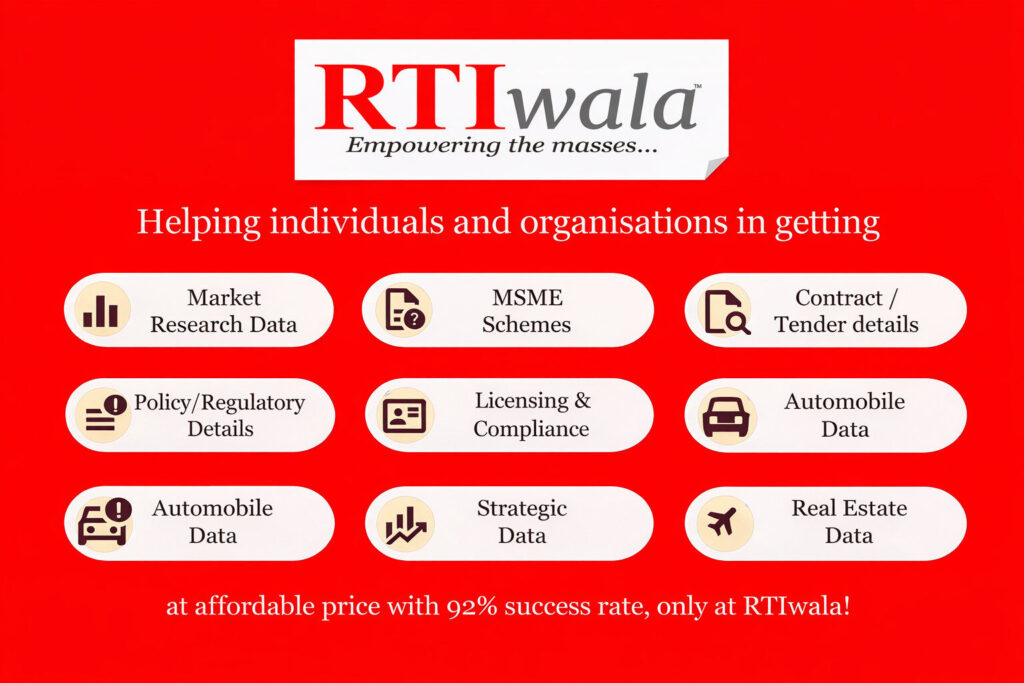
RTIwala helps B2B startups access official market research data collected by government departments through surveys, censuses, and sectoral studies. This includes industry-wise production data, district-level economic indicators, employment statistics, and sector growth reports.Such data is crucial for validating market size, identifying regional demand, and evaluating sector feasibility before investment. RTIwala uses RTI applications to request specific datasets not publicly released or fragmented across portals.Authorities like the Ministry of Statistics, state planning departments, district industries centers, and sector regulators typically hold this information. With official data in hand, businesses reduce guesswork and base strategies on documented evidence.
Industry survey reports → Market sizing and demand validation → Reduced entry risk
District/state statistics → Regional expansion planning → Location-specific decision.
Government economic indicators → Sector growth analysis → Better forecasting
Employment and production data → Supply-demand assessment → Strategic positioning
MSME Schemes & Benefits Data
Many B2B startups operate as MSMEs but lack clarity on which schemes apply, how benefits are distributed, and whether subsidies are actually released. RTIwala enables access to eligibility criteria, sanctioned amounts, beneficiary lists, and scheme-wise implementation status.This data is often held by MSME ministries, state industries departments, and nodal agencies. RTI provides a legal route to obtain scheme performance data, not just brochure-level information.For founders, this ensures accurate financial planning, avoids dependency on intermediaries, and clarifies whether incentives are real or merely announced.
Eligibility rules → Scheme applicability check → Correct benefit mapping
Beneficiary lists → Scheme transparency → Reduced misinformation
Subsidy release status → Cash flow planning → Financial certainty
Implementation reports → Policy effectiveness review → Strategic alignment
Import Export Data for Businesses
Exporters and importers require verified shipment data, trade volumes, and regulatory records to assess markets and compliance exposure. RTIwala helps businesses obtain non-public trade statistics from authorities such as Directorate General of Foreign Trade, customs departments, and port authorities.RTI-based data reveals shipment counts, product-wise trade flows, and region-specific trends—information often unavailable in consolidated form. This supports pricing strategy, partner evaluation, and export expansion planning.
Shipment statistics → Market demand analysis → Export feasibility
Product-wise trade data → Portfolio optimization → Revenue growth
Port/customs records → Compliance verification → Reduced penalties
Import-export trends → Competitive benchmarking → Strategic positioning
Contract / Tender Details
Government contracts represent large B2B opportunities, but transparency gaps often hinder fair participation. RTIwala enables access to tender documents, awarded contract details, bid evaluation criteria, and vendor selection records.These records are typically held by procurement departments, PSUs, and ministries. RTI-based access helps startups understand pricing benchmarks, qualification patterns, and evaluation logic—critical for competitive bidding.
Tender notices → Opportunity identification → Market access
Awarded contracts → Pricing insights → Better bids
Evaluation reports → Selection understanding → Higher success rates
Vendor data → Competitor analysis → Strategic positioning