










































Who Is the Assistant Registrar of Cooperative Societies and What Powers Do They Have?
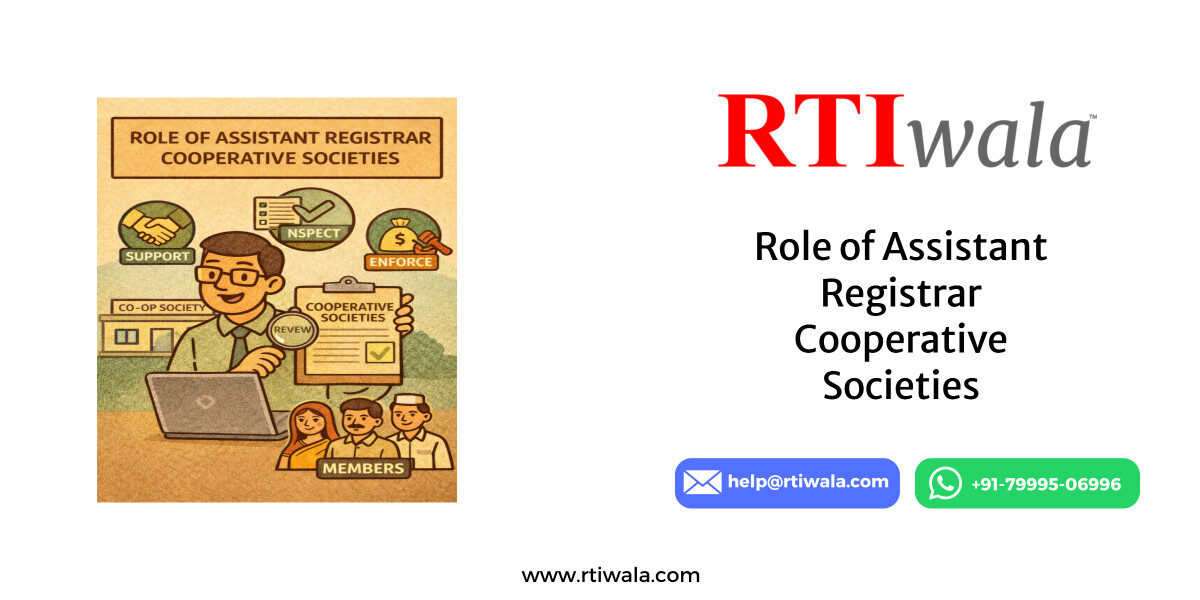
The Assistant Registrar of Cooperative Societies (ARCS) is a statutory authority appointed under the respective State Cooperative Societies Act. This officer functions as the first-level regulator and grievance authority for cooperative societies within an assigned jurisdiction (taluk, district, or zone). For most citizens, members, depositors, and employees, the Assistant Registrar is the closest and most accessible authority to raise issues against a cooperative society.
The core responsibility of the Assistant Registrar is to ensure that cooperative societies function strictly as per law, their registered bye-laws, and government directions. This role is not advisory in nature; it carries quasi-judicial and supervisory powers that directly affect the functioning of societies and their office bearers.
Key legal position of the Assistant Registrar:
- Acts under powers delegated by the Registrar of Cooperative Societies
- Exercises statutory authority under the State Cooperative Act
- Has jurisdiction over registration, supervision, inquiry, and enforcement
- Functions as an accountability checkpoint for cooperative governance
The Assistant Registrar is legally empowered to receive complaints, conduct inquiries, summon records, issue directions, and pass enforceable orders. Their actions are binding on cooperative societies unless stayed or set aside by higher authorities or courts.
Core powers of the Assistant Registrar include:
- Supervising day-to-day compliance of societies
- Ensuring adherence to registered bye-laws
- Monitoring elections, audits, and inspections
- Initiating action against mismanagement or illegality
From a citizen’s perspective, the Assistant Registrar is the first authority where violations must be reported before escalating the matter to the Registrar, Tribunal, or High Court. Courts and appellate bodies consistently expect complainants to first exhaust remedies before the Assistant Registrar.
No reply, no order, no progress? RTIwala activates RTI to fix accountability fast.
📞 Call: +91-7999-50-6996
💬 WhatsApp: https://cc.rti.link/wadp
🌐 www.rtiwala.com
What Complaints Can Be Filed Before the Assistant Registrar (Fraud, Mismanagement, Elections, Membership Issues)?
The Assistant Registrar has wide jurisdiction to entertain complaints covering almost every operational and governance aspect of a cooperative society. Any person who is directly affected—member, depositor, employee, voter, or even an eligible applicant—can approach this authority with documentary support.
Complaints before the Assistant Registrar are not limited to internal disputes. They also cover public interest violations, financial irregularities, and denial of statutory rights.
1. Fraud and Financial Irregularities
Complaints can be filed when there is suspicion or evidence of financial wrongdoing within the cooperative society. These matters are treated seriously because cooperative funds involve public money and member deposits.
Common fraud-related complaints include:
- Misappropriation of society funds
- Unauthorized withdrawals or loans
- Diversion of money without approval
- Fake entries in accounts or balance sheets
- Irregular investments violating statutory limits
The Assistant Registrar can order inspection, special audit, or inquiry and call for books of accounts, vouchers, and resolutions to verify the allegations.
2. Mismanagement and Abuse of Power by Office Bearers
When managing committee members or office bearers misuse their authority or act against the society’s interest, complaints can be filed directly before the Assistant Registrar.
Examples of mismanagement issues:
- Decisions taken without quorum or resolutions
- Violation of bye-laws or government circulars
- Failure to hold mandatory meetings
- Non-maintenance of statutory registers
- Arbitrary actions affecting members’ rights
Upon finding prima facie violations, the Assistant Registrar can issue directions, warnings, or initiate proceedings for removal or supersession as permitted by law.
3. Election-Related Complaints
The Assistant Registrar plays a critical role in ensuring free, fair, and lawful elections in cooperative societies. Election disputes are among the most common complaints received.
Election complaints may include:
- Failure to conduct elections on time
- Manipulation of voter lists
- Illegal rejection of nominations
- Conducting elections without proper notice
- Office bearers continuing beyond tenure
In such cases, the Assistant Registrar can intervene, halt illegal processes, or recommend appointment of an administrator or election officer as per statutory provisions.
4. Membership and Nominal Membership Disputes
Denial or manipulation of membership is a frequent tool used by cooperative managements to retain control. The law provides clear rights to eligible applicants and members.
Membership-related complaints include:
- Illegal rejection of membership applications
- Delay or refusal to issue share certificates
- Arbitrary removal or suspension of members
- Denial of voting rights without legal basis
- Non-refund of share capital on resignation
The Assistant Registrar can direct the society to grant membership, restore rights, or correct records after examining bye-laws and eligibility norms.
5. Employee and Service-Related Issues
In many states, cooperative society employees can also approach the Assistant Registrar for specific statutory violations.
Such complaints may cover:
- Illegal termination or suspension
- Non-payment of salary or statutory benefits
- Appointment without following recruitment rules
- Favoritism or irregular promotions
While pure service disputes may go to labor or cooperative tribunals, the Assistant Registrar can still examine legality of appointments and administrative compliance.
No reply, no order, no progress? RTIwala activates RTI to fix accountability fast.
📞 Call: +91-7999-50-6996
💬 WhatsApp: https://cc.rti.link/wadp
🌐 www.rtiwala.com
How the Assistant Registrar Controls, Inspects, and Audits Cooperative Societies
The Assistant Registrar of Cooperative Societies does not function passively after receiving complaints. The law empowers this authority to actively control, inspect, and audit cooperative societies to ensure legality, transparency, and protection of members’ interests. These powers are preventive as well as corrective, and they are exercised both on complaint and suo motu (on their own motion).
Control and inspection mechanisms exist because cooperative societies deal with public money, member deposits, elections, and statutory benefits. Any deviation from law or bye-laws attracts regulatory intervention at the Assistant Registrar level itself.
1. Statutory Control Over Cooperative Societies
The Assistant Registrar exercises ongoing supervisory control to ensure that societies function strictly within the Cooperative Act and registered bye-laws.
This control includes:
- Ensuring mandatory meetings (AGMs, managing committee meetings) are conducted
- Verifying quorum, resolutions, and decision-making processes
- Monitoring tenure of office bearers and committee validity
- Ensuring statutory filings and returns are submitted on time
If a society consistently violates statutory obligations, the Assistant Registrar can formally record non-compliance and initiate further proceedings.
2. Inspection of Records and Physical Verification
One of the most powerful tools available is the inspection power. On receiving a complaint—or even credible information—the Assistant Registrar can order inspection of society records.
Inspection typically covers:
- Cash books, ledgers, vouchers, and bank statements
- Membership registers and share allotment records
- Loan files, sanction approvals, and recovery status
- Minutes books and resolutions of meetings
- Election records and voter lists
Inspections are not limited to paperwork. The Assistant Registrar can also order physical verification of assets, offices, and functioning of the society.
This power is crucial in cases where:
- Records are manipulated or hidden
- Members are denied access to information
- Financial fraud is suspected
3. Audit and Special Audit Powers
Every cooperative society is subject to statutory audit. The Assistant Registrar supervises whether audits are conducted properly and on time.
Beyond routine audits, the Assistant Registrar can order:
- Special audit when financial irregularities are alleged
- Re-audit if earlier audit reports are suspicious or incomplete
- Thematic audit focused on specific transactions or periods
Audit findings can directly lead to:
- Fixing responsibility on specific office bearers
- Recovery proceedings for loss caused to the society
- Disqualification or removal of guilty members
Audit reports form strong documentary evidence for further legal action, appeals, and even criminal complaints.
4. Inquiry Proceedings Into Misconduct
When complaints disclose serious violations, the Assistant Registrar can initiate a formal inquiry under the Cooperative Act.
Inquiry proceedings involve:
- Issuing notices to the society and accused office bearers
- Calling for explanations and written replies
- Examining witnesses and documents
- Recording findings on each allegation
Such inquiries are quasi-judicial in nature. Findings recorded by the Assistant Registrar carry significant legal weight and are relied upon by higher authorities and courts.
No reply, no order, no progress? RTIwala activates RTI to fix accountability fast.
📞 Call: +91-7999-50-6996
💬 WhatsApp: https://cc.rti.link/wadp
🌐 www.rtiwala.com
What Actions the Assistant Registrar Can Take Against a Cooperative Society or Its Office Bearers
Based on inspections, audits, and inquiries, the Assistant Registrar is empowered to take direct enforcement action. These actions are not symbolic—they have real legal consequences for societies and individuals.
1. Issuing Binding Directions and Orders
The Assistant Registrar can issue written directions requiring the society to:
- Correct illegal decisions or resolutions
- Restore membership or voting rights
- Conduct overdue elections or meetings
- Produce records or comply with audit objections
Non-compliance with these directions can itself become a separate violation inviting stricter action.
2. Suspension or Removal of Office Bearers
If office bearers are found guilty of:
- Mismanagement
- Abuse of power
- Financial irregularities
- Persistent violation of law
The Assistant Registrar can recommend or directly order removal, suspension, or disqualification, depending on the State Act provisions.
This power is frequently used where:
- Committees act as private fiefdoms
- Elections are manipulated
- Funds are siphoned
3. Supersession of Managing Committee
In extreme cases, where the society’s functioning becomes unlawful or detrimental to members, the Assistant Registrar can initiate proceedings for supersession of the managing committee.
This results in:
- Removal of the entire committee
- Appointment of an administrator or government officer
- Temporary takeover of society management
Supersession is a serious step and is taken only after due process, but it remains a critical accountability mechanism.
4. Recovery and Surcharge Proceedings
If audit or inquiry establishes financial loss due to misconduct, the Assistant Registrar can initiate surcharge proceedings.
This allows:
- Recovery of misappropriated amounts
- Personal liability on responsible office bearers
- Attachment of property in some cases
Such proceedings ensure that losses are not borne by innocent members.
5. Referral for Criminal or Higher Legal Action
While the Assistant Registrar is not a criminal court, they can:
- Refer matters involving fraud or forgery to police
- Forward records to vigilance or prosecution agencies
- Enable members to approach tribunals or courts with official findings
Official records created at this stage become the foundation for future legal remedies.
No reply, no order, no progress? RTIwala activates RTI to fix accountability fast.
📞 Call: +91-7999-50-6996
💬 WhatsApp: https://cc.rti.link/wadp
🌐 www.rtiwala.com
What to Do If the Assistant Registrar Does Not Act on Your Complaint
In practice, many complainants face a common problem—the Assistant Registrar receives the complaint but does not pass any order, conduct inspection, or communicate progress. Silence, delay, or informal verbal assurances have no legal value. The law provides clear remedies when the Assistant Registrar fails to act within a reasonable time.
Inaction itself is a failure of statutory duty, and it can be challenged through documented, step-by-step legal escalation.
1. First Step: Create a Written Record of Inaction
The most important mistake complainants make is relying on verbal follow-ups. The moment there is no response, the issue must be formally recorded.
Actionable steps:
- Submit a written reminder referencing the original complaint date
- Clearly mention that no order, notice, or inspection has been initiated
- Ask for status of action taken under the relevant section of the Act
- Submit the reminder by registered post or official email
This converts silence into documented administrative delay, which is crucial for escalation.
2. Demand a Speaking Order, Not Just Action
The Assistant Registrar is legally bound to pass a reasoned (speaking) order—either allowing the complaint, rejecting it, or keeping it pending with reasons.
You must specifically ask for:
- Copy of any order passed
- Reasons for not initiating inquiry or inspection
- Legal provisions relied upon for inaction
A non-speaking or absent order violates principles of natural justice and strengthens your case for appeal.
3. Escalation to the Registrar of Cooperative Societies
If the Assistant Registrar remains inactive despite reminders, the next statutory authority is the Registrar of Cooperative Societies.
The escalation complaint should include:
- Copy of original complaint
- Proof of submission and reminders
- Evidence of inaction or delay
- Clear request for supervisory intervention
The Registrar has powers to:
- Call for records from the Assistant Registrar
- Transfer the case to another officer
- Direct immediate inspection or inquiry
- Initiate disciplinary action for negligence
Escalation works only when backed by documented proof, not oral allegations.
4. Use Legal Notice or Representation as Pressure Tool
Before approaching courts or tribunals, a formal legal representation can be sent to the department.
This representation should:
- Cite statutory duties of the Assistant Registrar
- Highlight violation due to non-action
- Fix a reasonable time limit for response
- Warn of further legal remedies
Many cases move forward at this stage because departments try to avoid adverse records.
5. Judicial Remedies for Prolonged Inaction
When administrative remedies fail, the law allows judicial intervention.
Available remedies include:
- Filing writ petition for direction to decide the complaint
- Challenging arbitrary inaction as abuse of power
- Seeking time-bound disposal orders
Courts generally do not decide cooperative disputes directly at this stage, but they force authorities to act, which is often the real objective.
No reply, no order, no progress? RTIwala activates RTI to fix accountability fast.
📞 Call: +91-7999-50-6996
💬 WhatsApp: https://cc.rti.link/wadp
🌐 www.rtiwala.com
How to Get Official Records, Orders, and File Status from the Assistant Registrar Through Legal Means
Access to official records is the strongest weapon against delay, denial, and manipulation. Without records, authorities can always claim “matter under process.” The law provides clear methods to obtain certified, verifiable information.
1. Right to Seek File Status and Action Taken
You are legally entitled to know:
- Whether your complaint file has been opened
- File number and date of registration
- Officer handling the matter
- Action taken till date
This information must be provided in writing. It eliminates ambiguity and exposes administrative stalling.
2. Obtaining Copies of Orders, Notes, and Reports
Official records that can be legally obtained include:
- Inspection orders and reports
- Audit reports and objections
- Inquiry notices and findings
- Orders passed on complaints
- File notings and movement details
These documents reveal who delayed the file, who examined it, and why action was or was not taken.
3. Why Certified Records Matter
Certified copies have legal value. They can be used:
- In appeals before Registrar or Tribunal
- In court proceedings
- To fix accountability on specific officers
- To counter false oral claims
Without certified records, authorities often deny past assurances or actions.
4. Preventing Silent Closure or Manipulation
Many complaints are quietly “filed” without decision. Records expose:
- Date-wise movement of file
- Whether inspection was ordered or not
- Whether society replied or ignored notices
- Whether reasons for closure were recorded
Once records are demanded, arbitrary closure becomes risky for officials.
5. Strategic Advantage of Record-Based Action
When you possess official records:
- Authorities respond faster
- Escalation becomes effective
- Legal remedies become stronger
- Cooperative societies lose the ability to deny facts
Most successful cooperative disputes are resolved not by arguments, but by documents obtained through lawful means.
No reply, no order, no progress? RTIwala activates RTI to fix accountability fast.
📞 Call: +91-7999-50-6996
💬 WhatsApp: https://cc.rti.link/wadp
🌐 www.rtiwala.com
Assistant Registrar of Cooperative Societies
1. Can I directly file a complaint against a cooperative society before the Assistant Registrar?
Yes. Any member, depositor, employee, or affected person can directly file a written complaint before the Assistant Registrar for issues like fraud, mismanagement, elections, or membership denial.
2. What legal powers does the Assistant Registrar have over cooperative societies?
The Assistant Registrar has statutory powers to inspect records, order audits, conduct inquiries, issue binding directions, suspend office bearers, and initiate recovery or supersession proceedings.
3. How long should the Assistant Registrar take to act on a complaint?
There is no fixed timeline in most State Acts, but reasonable action is expected within 30–60 days. Prolonged silence or inaction can be legally challenged as failure of statutory duty.
4. What can I do if the Assistant Registrar ignores my complaint?
You can submit written reminders, demand a speaking order, escalate the matter to the Registrar of Cooperative Societies, and seek official records to prove inaction before pursuing legal remedies.
5. Can the Assistant Registrar order an audit or inspection based on my complaint?
Yes. If the complaint discloses financial irregularities or governance violations, the Assistant Registrar can order inspection, special audit, or inquiry under the Cooperative Societies Act.
6. Are election disputes of cooperative societies handled by the Assistant Registrar?
Yes. Issues like delayed elections, voter list manipulation, illegal nominations, or continuation beyond tenure fall within the Assistant Registrar’s regulatory jurisdiction.
7. Can I obtain copies of orders and file status from the Assistant Registrar’s office?
Yes. You are legally entitled to obtain file status, certified copies of orders, inspection reports, audit findings, and inquiry records to ensure transparency and accountability.
8. Are Assistant Registrar’s orders legally enforceable?
Yes. Orders passed by the Assistant Registrar are binding on cooperative societies unless stayed or overturned by the Registrar, Cooperative Tribunal, or a competent court.
No reply, no order, no progress? RTIwala activates RTI to fix accountability fast.
📞 Call: +91-7999-50-6996
💬 WhatsApp: https://cc.rti.link/wadp
🌐 www.rtiwala.com