
































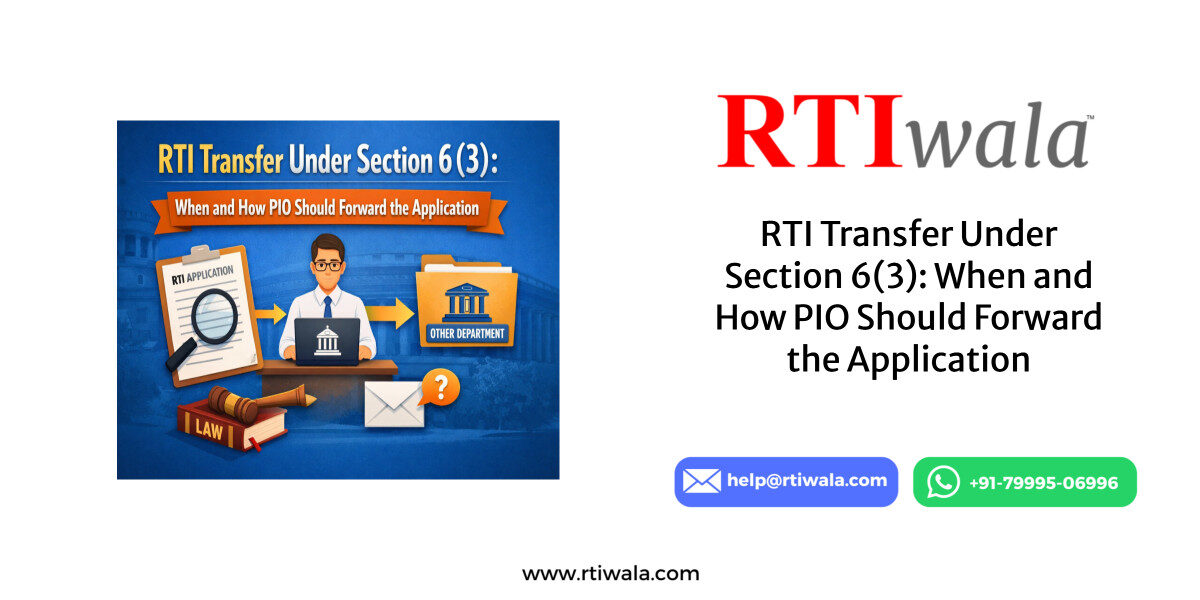
What Is RTI Transfer Under Section 6(3)
RTI transfer under Section 6(3) of the RTI Act, 2005 applies when an RTI application is filed with the wrong public authority. Many applicants unknowingly send their RTI to a department that does not actually hold the requested information. The law protects the applicant in such cases and shifts responsibility to the Public Information Officer (PIO).
Section 6(3) clearly states that the applicant cannot be punished for filing with the wrong authority. If the information requested relates to another public authority, the PIO who received the RTI must transfer it instead of rejecting it. This provision exists to prevent harassment, delay, and technical rejections.
In simple terms, RTI transfer means:
- Your RTI remains valid even if sent to the wrong office
- The PIO must forward it to the correct authority
- You should not be asked to file a fresh RTI again
This section is crucial because many departments misuse jurisdiction rules to escape accountability. Section 6(3) legally blocks such avoidance and ensures information reaches the correct custodian without restarting the process.
For RTI applicants, this means:
- No loss of RTI fee
- No loss of original RTI date
- No excuse for rejection based on “wrong department”
Understanding this provision empowers applicants to challenge illegal rejections and delays confidently.
Facing RTI delay or no reply? RTIwala uses RTI to force accountability and written proof—
📞 Call: +91-7999-50-6996 |
💬 WhatsApp: https://cc.rti.link/wadp
🌐 www.rtiwala.com
When Is the PIO Legally Required to Transfer an RTI
A PIO is legally bound to transfer an RTI application when the information requested is held by another public authority or more closely connected with another authority. This is not optional, discretionary, or dependent on internal convenience.
The obligation to transfer arises immediately when the PIO realizes:
- The requested records are not available in their office
- Another department controls or maintains the information
- The subject matter falls under another public authority’s jurisdiction
Importantly, the PIO cannot reject the RTI simply because the applicant chose the wrong authority. Courts and Information Commissions have repeatedly held that such rejection violates Section 6(3).
A PIO must transfer the RTI when:
- Land records are held by the Revenue Department, not the Municipality
- Service records are with Head Office, not the local unit
- Scheme data is maintained by the State Department, not the District Office
The law also clarifies that partial transfers are allowed. If some information is available with the receiving PIO and some with another authority, the PIO must:
- Answer the part available with them
- Transfer the remaining queries to the correct authority
Time Limit for RTI Transfer and Calculation of 30 Days
One of the most misunderstood aspects of RTI transfer under Section 6(3) is how timelines are calculated. Many applicants assume that once an RTI is transferred, the 30-day response period restarts. This is incorrect and often misused by public authorities to delay replies.
Under the RTI Act, when an RTI is transferred:
- The PIO must transfer it within 5 days of receiving the application
- The original RTI filing date remains unchanged
- The total response time does not reset to 30 days again
This means the clock starts ticking from the day you first filed the RTI, not from the date of transfer. Any delay beyond this is treated as a violation of Section 7(1).
Correct time calculation works like this:
- Day 1: Applicant files RTI with the wrong authority
- By Day 5: PIO must transfer it to the correct authority
- By Day 30: Final reply must be given (including transfer time)
If the PIO delays transfer:
- The delay is counted against the department
- The applicant gains grounds for appeal
- Penalty exposure increases for the PIO
Many PIOs wrongly claim:
- “30 days will be counted after transfer”
- “Fresh RTI date applies”
- “Delay occurred due to jurisdiction confusion”
All such explanations are legally invalid. Information Commissions have consistently ruled that delay caused by internal transfer is not the applicant’s fault.
For applicants, this clarity helps in:
- Tracking response deadlines accurately
- Filing First Appeal on the correct date
- Proving delay beyond statutory limits
Knowing the exact timeline rules prevents departments from stretching RTI replies indefinitely under the excuse of transfer.
Facing RTI delay or no reply? RTIwala uses RTI to force accountability and written proof—
📞 Call: +91-7999-50-6996 |
💬 WhatsApp: https://cc.rti.link/wadp
🌐 www.rtiwala.com
Common Mistakes PIOs Make While Transferring RTI
Despite clear legal provisions, RTI transfers under Section 6(3) are often mishandled by PIOs. These mistakes are not minor procedural lapses — many amount to direct violations of the RTI Act and can be challenged effectively.
The most common mistake is rejecting the RTI instead of transferring it. PIOs often write vague replies stating “information does not pertain to this office” without forwarding the application. This is illegal and defeats the purpose of Section 6(3).
Other frequent mistakes include:
- Asking the applicant to file a fresh RTI
- Returning the RTI application unprocessed
- Transferring without informing the applicant
- Transferring after the 5-day limit
Another serious issue is wrong or incomplete transfer. PIOs sometimes send the RTI to:
- An unrelated department
- A lower office without record custody
- An authority lacking decision-making power
Partial transfer errors are also common. Instead of answering available information and transferring the rest, PIOs:
- Transfer the entire RTI unnecessarily
- Avoid responding to questions they already hold
Some PIOs misuse technical language such as:
- “RTI not maintainable”
- “No jurisdiction”
- “Outside scope of this office”
Facing RTI delay or no reply? RTIwala uses RTI to force accountability and written proof—
📞 Call: +91-7999-50-6996 |
💬 WhatsApp: https://cc.rti.link/wadp
🌐 www.rtiwala.com
Frequently Asked Questions (FAQs)
1. What is RTI transfer under Section 6(3) of the RTI Act?
RTI transfer under Section 6(3) applies when an RTI application is filed with the wrong public authority. In such cases, the receiving PIO must forward the RTI to the correct authority instead of rejecting it.
2. Can a PIO reject an RTI for wrong department instead of transferring it?
No. A PIO is legally prohibited from rejecting an RTI solely on the ground of wrong jurisdiction. Section 6(3) makes transfer mandatory when another authority holds the information.
3. Within how many days must a PIO transfer an RTI application?
The RTI Act requires the PIO to transfer the application within 5 days of receiving it. Any transfer beyond this period is treated as a legal delay.
4. Does the 30-day RTI reply period restart after transfer?
No. The 30-day time limit is counted from the original RTI filing date, not from the date of transfer. Internal transfer delays cannot extend the statutory timeline.
5. What should I do if my RTI is rejected instead of being transferred?
You should file a First Appeal citing violation of Section 6(3). Filing a fresh RTI or paying the fee again is not required and weakens your legal position.
6. How can I know whether my RTI was properly transferred?
A valid transfer must be communicated in writing, mention Section 6(3), identify the new public authority, and be done within 5 days. Absence of these indicates improper transfer.
7. Is partial transfer of RTI questions allowed under Section 6(3)?
Yes. If some information is available with the original PIO and some with another authority, the PIO must reply to the available part and transfer the remaining questions.
8. Can a PIO be penalized for not transferring an RTI?
Yes. Failure to transfer an RTI when required can lead to penalty proceedings under Section 20 of the RTI Act, including monetary fines and disciplinary action.