




























Table of Content
Many RTI applicants face one common problem.
Instead of legally valid certified copies, the Public Information Officer (PIO) sends only simple photocopies or incomplete papers.
These plain copies are useless for court cases, complaints, or official verification.
The solution is not filing multiple RTIs but using the correct legal process under the RTI Act to demand attested records properly.
This guide explains exactly how to request, enforce, and obtain certified copies without delay or rejection.
How to Request Certified or Attested Copies Under RTI (Correct Format to Avoid Rejection)
Most rejections happen because applicants simply write “provide documents.”
PIOs then send normal photocopies because certification was never clearly demanded.
Under Section 2(j)(ii) of the RTI Act, every citizen has the right to obtain certified copies of records.
This means stamped, signed, and officially authenticated documents, not plain prints.
Follow these steps while filing RTI:
- Clearly write: “Provide certified/attested copies with official seal and signature.”
- Mention “as per Section 2(j)(ii) of RTI Act.”
- Specify document name, date, file number, and department.
- Avoid vague words like “all records” or “complete details.”
Correct wording reduces excuses and prevents partial replies.
Precise requests force the PIO to supply legally valid copies.
If inspection is required, you can also write:
- “Permit inspection of files and provide certified copies of selected pages.”
This method works faster and gives you exactly what you need.
Not getting certified copies from the department? RTIwala helps you legally obtain attested documents fast —
📞 Call: +91-7999-50-6996
💬 WhatsApp: https://help.rti.link/
🌐 www.rtiwala.com
What to Do If PIO Gives Only Photocopies or Refuses Certified Documents
Receiving plain photocopies is very common.
However, this is not legally sufficient when certified copies are requested.
A plain copy has:
- No seal
- No signature
- No authenticity
- No evidentiary value
Such documents are often rejected by courts or authorities.
If this happens, do not file a fresh RTI.
Instead, treat it as an incomplete information supply.
Take these actions immediately:
- Check whether you clearly asked for certified copies
- Compare response with your RTI wording
- Note missing stamps/signatures
- Keep envelope and reply date for proof
Then send a written objection or move to First Appeal.
Grounds you can use:
- “Certified copies requested but not provided”
- “Information supplied is incomplete”
- “Violation of Section 2(j)(ii) rights”
- “Records not properly authenticated”
This approach legally pressures the PIO.
Filing another RTI only restarts the 30-day clock and wastes time.
Always escalate instead of repeating.
First Appeal Steps to Get Legally Valid Certified Copies Without Delay
When PIO ignores certification or refuses documents, the First Appeal is the fastest solution.
It forces the department’s senior officer (FAA) to review the case.
File the appeal within 30 days of receiving the reply or after 30 days of no response.
Follow this process:
Step 1: Mention your RTI details
- Application number
- Filing date
- PIO name/office
Step 2: State the problem clearly
- “Certified copies were requested but only photocopies supplied”
- or “Information denied without reason”
Step 3: Cite legal rights
- Section 2(j)(ii) – Right to certified copies
- Section 7 – Complete and proper information
Step 4: Ask specific relief
- Provide certified copies with seal/signature
- Free supply due to incomplete response
- Action against PIO for deficiency
Attach:
- RTI copy
- PIO reply
- Proof of incomplete documents
Avoid emotional language.
Stick to facts and legal violations only.
In most cases, departments comply at First Appeal stage itself.
Because once recorded, non-compliance can lead to penalties under Section 20.
This pressure makes PIOs provide certified copies quickly.
After filing RTI or First Appeal, many applicants still feel confused.
Questions usually arise like: What makes a copy legally valid? How much fee is payable? How long should it take? Can these copies be used in court or complaints?
Knowing these practical rules helps avoid unnecessary delays and arguments with departments.
This part explains exactly what the PIO must legally do and how you can enforce compliance step by step.
Certified Copies Rules Under RTI Act: PIO Duties, Stamps, Signatures and Legal Validity
A certified copy is not just a photocopy.
It is an officially authenticated record that proves the document is true and taken from government files.
When you request certified copies, the PIO has specific responsibilities.
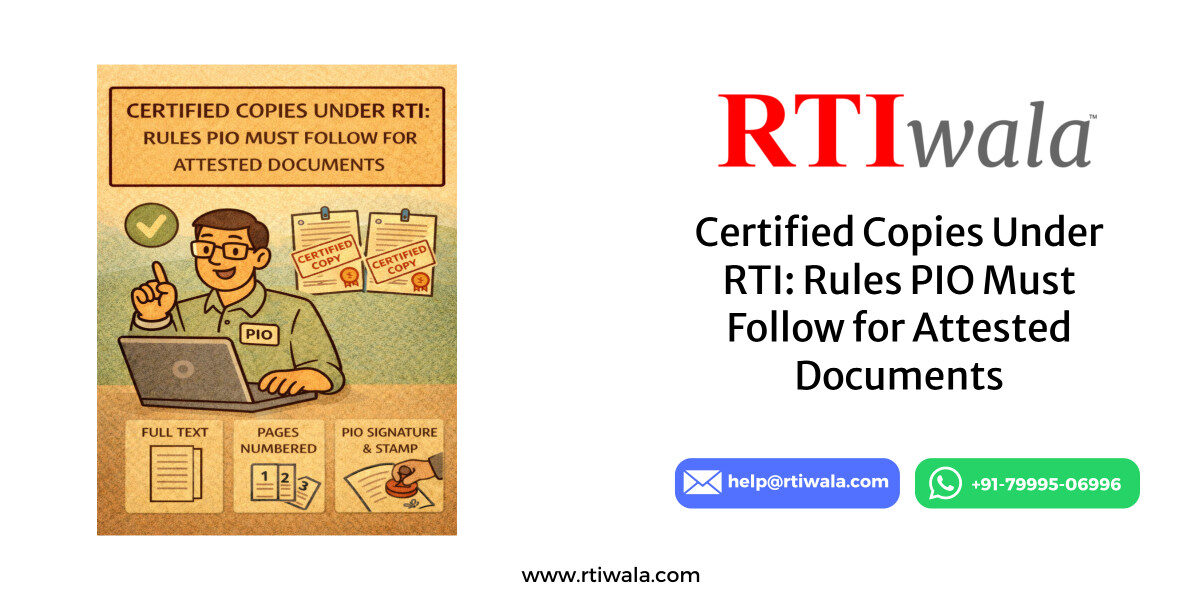
A legally valid certified copy must contain:
- Official seal or stamp of the department
- Signature of PIO or authorized officer
- Date of certification
- “True copy” or “Certified copy” endorsement
- Proper page numbering where required
Without these elements, the document has no evidentiary strength.
Courts, police, or higher authorities may reject it as unofficial.
PIO cannot:
- Send unsigned prints
- Send scanned soft copies without certification (unless digitally signed)
- Remove important pages
- Provide partially certified sets
If any of these happen, it is considered incomplete information under the law.
Always check each page carefully after receiving the documents.
If certification is missing even on one page, you can challenge it in appeal.
Not getting certified copies from the department? RTIwala helps you legally obtain attested documents fast —
📞 Call: +91-7999-50-6996
💬 WhatsApp: https://help.rti.link/
🌐 www.rtiwala.com
Fees, Time Limits, and Inspection Rights for Obtaining Attested Records
Many applicants overpay or get delayed because they don’t know the correct fee and timeline rules.
Understanding these limits helps you avoid exploitation.
Standard government RTI fee structure:
- Application fee + Postal charge
- Copy charges: ₹2 per page (usually A4/A3)
- Larger records: actual cost
- Inspection: first hour free, then nominal hourly charges
PIO must first send an intimation letter if extra fees apply.
You are required to pay only after receiving this notice.
Important time limits:
- Normal cases: 30 days
- Life and liberty matters: 48 hours
- If fee notice issued: time stops until payment
- After payment: copies must be provided promptly
If the department delays beyond legal timelines without reason, information should be provided free of cost.
Inspection is a powerful option many people ignore.
Benefits of inspection:
- See entire file before selecting pages
- Avoid unnecessary copying charges
- Identify hidden or missing records
- Ask for certified copies of only relevant pages
You can write:
“Allow inspection of records and provide certified copies of selected documents.”
This method saves money and ensures accuracy.
When Certified Copies Help in Court, Complaints, and Official Verification
Certified copies are not just paperwork.
They act as legal proof in many situations.
These documents are commonly used for:
- Court cases and litigation
- Police complaints
- Consumer disputes
- Service or pension claims
- Property and land disputes
- Departmental corruption complaints
- Appeals before commissions or tribunals
Authorities trust certified copies because they come directly from official records.
They carry higher credibility than screenshots or simple prints.
For example:
- A certified file noting proves decision-making process
- A certified sanction letter confirms approval status
- A certified attendance or payment register shows factual evidence
Without certification, these papers may be treated as informal.
If you plan any legal action, always insist on certified copies from the beginning.
It saves time later and strengthens your case.
Final Practical Checklist Before Closing Your RTI
Before accepting documents, verify:
- Seal and signature on every page
- Complete set of records supplied
- Correct number of pages
- Fee charged as per rules only
- Delivery within legal timeline
If any issue exists:
- File First Appeal immediately
- Quote incomplete or uncertified supply
- Seek certified copies free of cost
Do not compromise with plain photocopies.
Properly attested documents protect your legal rights and make your RTI effective.
FAQ
1. How do I specifically ask for certified or attested copies in an RTI application?
Write clearly: “Provide certified/attested copies of the requested records with official seal and signature under Section 2(j)(ii) of the RTI Act.”
Avoid vague words like “documents” or “details.” Always mention certification explicitly to prevent the PIO from sending plain photocopies.
2. Is the PIO legally bound to give certified copies under RTI?
Yes. Section 2(j)(ii) gives every citizen the right to obtain certified copies of records.
If certification is requested, the PIO cannot legally provide only simple photocopies or unsigned documents.
3. What if the PIO sends only photocopies without seal or signature?
Treat it as incomplete information.
File a First Appeal stating that certified copies were requested but not supplied. Ask for properly attested copies free of cost due to deficiency.
4. What makes a document legally valid as a certified copy?
A valid certified copy must include:
- Department seal/stamp
- PIO or authorized officer signature
- Date
- “True copy” or “Certified copy” marking
Without these, the document has weak or no legal value.
5. How much fee is charged for certified copies under RTI?
Normally:
- ₹10 application fee
- ₹2 per page for copies
- First hour inspection free
The department must inform you of additional charges before collecting payment. Overcharging is not allowed.
6. Can I inspect records before taking certified copies?
Yes. You have the legal right to inspect files first.
After inspection, you can select only required pages and request certified copies, which saves time and reduces copying costs.
7. What is the time limit for receiving certified copies from the PIO?
The PIO must supply information within 30 days.
If the timeline is crossed without valid reason, the information should be provided free of cost, including certified copies.
8. Are certified copies obtained through RTI valid in court or legal proceedings?
Yes. Certified copies carry official authenticity and are generally accepted by courts, tribunals, police authorities, and government offices as valid documentary evidence.