

































What Is RTI Second Appeal and When Is It Required
RTI Second Appeal is the final statutory remedy available to an RTI applicant when information is denied, delayed, or improperly handled even after filing the First Appeal. It is filed before the Central Information Commission or the respective State Information Commission, depending on the public authority involved. This stage comes only after the First Appeal route has been exhausted or ignored.
A Second Appeal becomes necessary when the First Appellate Authority (FAA) fails to pass an order within the prescribed time or passes an order that is incomplete, vague, or legally incorrect. Many applicants mistakenly believe Second Appeal is optional, but in reality, it is the only way to enforce accountability at the commission level.
RTI Second Appeal is required in situations such as:
- No reply received from the FAA within the legal time
- FAA order upholds illegal denial by the PIO
- Information supplied is misleading, partial, or false
- Exemptions are wrongly applied without justification
Practically, Second Appeal is where real scrutiny happens, as commissions can summon records, hear arguments, and pass binding directions on public authorities.
RTI Second Appeal Time Limit as Per RTI Act
The RTI Act clearly prescribes a 90-day time limit for filing a Second Appeal. This time limit is mentioned under Section 19(3) of the Right to Information Act, and it is strictly followed by Information Commissions in most cases.
The 90-day period is not flexible by default. It is calculated as a statutory limitation, and applicants are expected to act within this window. Filing beyond this period automatically weakens the appeal unless strong legal reasons are shown.
Key points about the RTI Second Appeal time limit:
- Maximum time allowed: 90 days
- Applies uniformly across Central and State Commissions
- Delay requires written justification
- No automatic condonation of delay
In practice, many Second Appeals are dismissed at the registry level only due to time-bar issues, even before merits are examined. This is why understanding the time limit is not optional—it directly impacts admissibility.
RTI Second Appeal delayed or rejected? RTIwala fixes timelines, drafts correctly, and pushes accountability:-
📞 Call: +91-7999-50-6996
💬 WhatsApp: https://help.rti.link/
🌐 www.rtiwala.com
From Which Date the RTI Second Appeal Time Limit Is Calculated
One of the most confusing areas for RTI applicants is identifying the correct start date for calculating the 90-day limitation period. The RTI Act recognizes multiple trigger points depending on how the First Appeal stage concluded.
The time limit for RTI Second Appeal is calculated from:
- The date of receipt of the FAA’s order, OR
- The date on which the FAA should have passed the order but failed to do so
If the FAA passes a written order, the clock starts from the actual date you received or were deemed to have received that order. If no order is passed, the clock starts from the expiry of the FAA’s maximum response period.
Standard calculation rules applicants must follow:
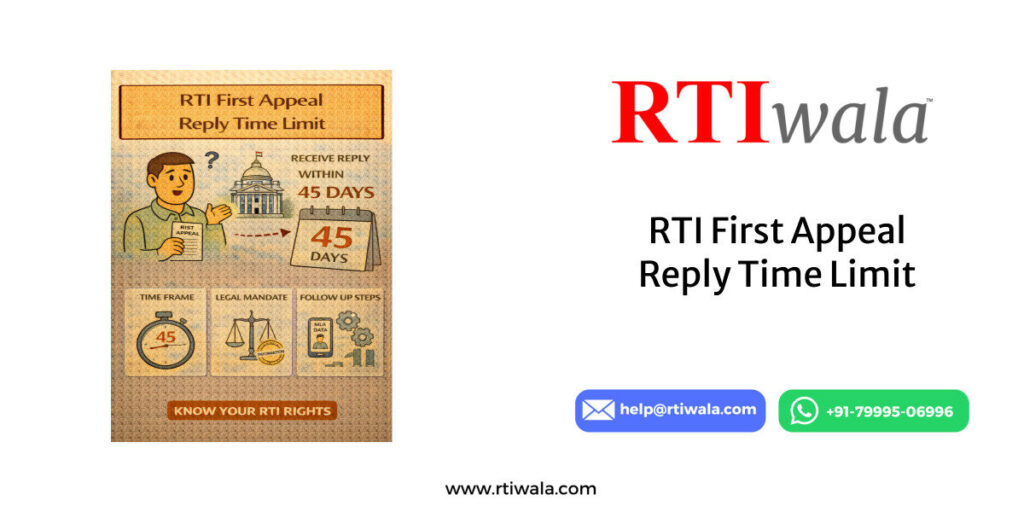
- FAA has 30 days, extendable to 45 days, to decide First Appeal
- On day 46, limitation for Second Appeal begins
- Delay in postal delivery is generally not accepted without proof
Incorrect date calculation is one of the top reasons for rejection, so applicants must preserve acknowledgment receipts, email logs, and appeal filing dates to prove timelines accurately.
What Happens If RTI Second Appeal Is Filed Late
Filing an RTI Second Appeal after the prescribed time limit has serious legal consequences. Under Section 19(3) of the Right to Information Act, the Information Commission may admit a delayed appeal only if sufficient cause is proven. There is no automatic acceptance—delay is examined strictly at the threshold stage.
When a Second Appeal is filed late, the Commission first checks limitation compliance before looking at merits. If the delay explanation is weak, generic, or unsupported by documents, the appeal is rejected without any hearing. This rejection is final and closes the RTI route permanently for that application.
Common outcomes of late filing include:
- Appeal dismissed as time-barred
- Registry returns the appeal without registration
- No hearing on denial or incorrect information
- Loss of statutory right to challenge the PIO/FAA action
To seek condonation of delay, the applicant must submit a clear, factual, and documented explanation (medical emergency, non-receipt of FAA order with proof, etc.). Mere ignorance of law or casual delay is not accepted.
Documents Required Before Filing RTI Second Appeal
RTI Second Appeal is a document-driven legal process. Missing or incorrect documents can lead to rejection even if the case is otherwise strong. Information Commissions insist on a complete paper trail showing compliance with every previous RTI step.
Before filing, ensure the following documents are ready and properly arranged:
- Copy of the original RTI application
- Proof of RTI fee payment
- Copy of PIO reply (if received)
- Copy of First Appeal filed
- Proof of First Appeal submission
- FAA order copy, if issued
- Delay explanation affidavit (if applicable)
Each document must clearly show dates, authority names, and reference numbers. Any mismatch in dates between RTI, First Appeal, and Second Appeal creates suspicion and weakens credibility.
Practical filing mistakes to avoid:
- Uploading blurred or unreadable copies
- Missing proof of First Appeal filing
- Incorrect public authority details
- Filing without a proper index or sequence
A properly documented appeal increases the chance of registration, hearing, and final relief.
RTI Second Appeal delayed or rejected? RTIwala fixes timelines, drafts correctly, and pushes accountability:-
📞 Call: +91-7999-50-6996
💬 WhatsApp: https://help.rti.link/
🌐 www.rtiwala.com
Difference Between RTI First Appeal and Second Appeal Time Limit
Understanding the difference between First Appeal and Second Appeal timelines is critical because each stage has independent legal clocks. Confusing these timelines often results in applicants missing the Second Appeal window.
Key differences in time limits:
- First Appeal: Filed within 30 days of PIO reply or no reply
- FAA decision period: 30 days, extendable to 45 days
- Second Appeal: Filed within 90 days from FAA order or default date
The First Appeal is an internal departmental remedy, while the Second Appeal is an independent quasi-judicial proceeding before the Central Information Commission or State Information Commission. Because of this, the Second Appeal time limit is treated more strictly.
Critical distinctions applicants must remember:
- First Appeal delay is often condoned liberally
- Second Appeal delay faces strict scrutiny
- FAA silence triggers Second Appeal clock
- Wrong assumption about dates leads to rejection
Practically, many applicants wait endlessly for FAA replies, not realizing that inaction itself starts the Second Appeal limitation.
Common Mistakes That Lead to Rejection of RTI Second Appeal
A large number of RTI Second Appeals fail not because of weak cases, but due to avoidable procedural mistakes. Information Commissions prioritize procedural compliance as much as substantive issues.
Most common rejection-triggering mistakes include:
- Miscalculation of the 90-day limitation period
- Filing without exhausting First Appeal remedy
- No proof of First Appeal submission
- Vague or emotional grounds without legal basis
- Seeking explanations or opinions instead of records
Another major error is copy-paste drafting without linking facts to violations under the RTI Act. Commissions expect clarity on how the PIO or FAA violated statutory duties.
Additional errors applicants often overlook:
- Filing against the wrong public authority
- Mixing multiple RTI issues in one appeal
- Not signing or verifying the appeal properly
- Uploading incomplete annexures
Avoiding these mistakes significantly improves the chances of admission, hearing, and enforceable orders from the Commission.
Common Mistakes That Lead to Rejection of RTI Second Appeal (Advanced Practical Insights)
Even when applicants understand timelines and documentation, RTI Second Appeals still get rejected due to strategic and procedural gaps at the final stage. Information Commissions function as quasi-judicial bodies and expect applicants to demonstrate discipline, clarity, and legal awareness throughout the appeal.
One critical mistake is treating the Second Appeal as a complaint rather than a statutory appeal. Emotional narratives, allegations without evidence, or unrelated grievances dilute the core RTI violation and weaken credibility before the Commission.
High-impact mistakes that applicants must strictly avoid:
- Drafting grounds without linking them to RTI Act violations
- Repeating RTI questions instead of challenging denial or delay
- Seeking explanations, justifications, or opinions
- Mixing grievance redressal with RTI appeal
The Commission focuses only on whether the PIO/FAA violated the RTI Act, not on personal hardship. Appeals that stay legally focused have significantly higher admission and success rates.
Procedural Errors That Kill an Otherwise Strong RTI Second Appeal
Many Second Appeals fail before registration due to avoidable technical defects. Registries of the Central Information Commission and State Information Commission conduct strict scrutiny at the filing stage itself.
Procedural lapses that frequently lead to rejection:
- Filing Second Appeal without waiting for FAA time to lapse
- Incorrect calculation of FAA default date
- Missing annexure numbering or index
- Uploading incomplete or mismatched documents
Another serious error is filing against the wrong authority—for example, filing before the Central Commission for a State subject. Such appeals are rejected outright, irrespective of merit.
Applicants must ensure:
- Correct Commission jurisdiction
- Consistent dates across all documents
- Clear referencing of annexures in grounds
- Proper verification and signature
These details reflect seriousness and directly affect how the appeal is perceived.
Why Most Applicants Lose at RTI Second Appeal Stage
RTI Second Appeal is not just about facts—it is about presentation, precision, and procedural compliance. Many applicants wrongly assume that denial of information automatically guarantees relief at the Commission level.
In reality, the Commission examines:
- Whether statutory timelines were followed
- Whether exemptions were legally applied
- Whether grounds are specific and evidence-based
- Whether the applicant exhausted all remedies
If any of these elements are weak or missing, the appeal fails regardless of how genuine the information need is.
Key reasons applicants lose:
- Weak articulation of RTI violations
- Poorly structured grounds
- No focus on “information denial”
- Overlooking limitation compliance
A Second Appeal must read like a clear legal challenge, not a continuation of correspondence with the department.
RTI Second Appeal delayed or rejected? RTIwala fixes timelines, drafts correctly, and pushes accountability:-
📞 Call: +91-7999-50-6996
💬 WhatsApp: https://help.rti.link/
🌐 www.rtiwala.com
Practical Final Checklist Before Filing RTI Second Appeal
Before submitting the appeal, applicants should pause and verify compliance against a non-negotiable checklist. This step alone can prevent rejection and save months of effort.
Final verification checklist:
- Limitation calculated correctly (within 90 days)
- FAA order or default date clearly mentioned
- All documents indexed and legible
- Grounds strictly linked to RTI Act provisions
- Jurisdiction of Commission verified
Applicants should remember that the Second Appeal is the last statutory remedy under the RTI Act. Once rejected, there is no routine corrective route available.
Frequently Asked Questions (FAQs)
1. What is the time limit for filing a Second Appeal under RTI?
The time limit for filing a Second Appeal under the RTI Act is 90 days from the date of the First Appellate Authority’s order or from the date when the order should have been passed.
2. From which date is the RTI Second Appeal time limit counted?
The 90-day period is counted from the date of the FAA’s written order, or if no order is passed, from the expiry of the FAA’s reply period.
3. Can I file a Second Appeal if the First Appellate Authority did not reply?
Yes, if the FAA does not pass any order within the prescribed time, you can file a Second Appeal after the FAA reply period ends, treating it as deemed refusal.
4. What happens if I miss the 90-day time limit for Second Appeal?
If the Second Appeal is filed late, the Information Commission may ask for a delay justification and can reject the appeal if the explanation is not satisfactory.
5. Is delay in filing RTI Second Appeal always condoned?
No, delay condonation is not automatic. The Commission allows it only in exceptional cases supported by valid proof, such as medical emergencies or unavoidable circumstances.
6. Is First Appeal mandatory before filing a Second Appeal?
Yes, filing a First Appeal is mandatory. A Second Appeal filed without completing the First Appeal stage is usually rejected.
7. Can new questions be added in the RTI Second Appeal?
No, new questions or information requests cannot be added in a Second Appeal. The appeal is strictly limited to issues raised in the original RTI application.
8. Which authority hears the RTI Second Appeal?
The RTI Second Appeal is heard by the Central Information Commission or State Information Commission, depending on the public authority involved.