




































Filing a Right to Information (RTI) application is an essential step towards transparency and accountability. However, what happens if your Online RTI Application is not answered? This article will guide you through the steps you need to take to ensure you get the information you seek. RTIwala is here to help you navigate this process effectively.
If you face delays, rejections, or no response to your online RTI application, the RTIwala Team is here to help! Visit RTIwala.com or call +91-7999-50-6996 for expert assistance in filing appeals and ensuring you get the information you seek.
Understanding the RTI Act
The RTI Act of 2005 empowers citizens to request information from public authorities. These authorities are required to respond to RTI applications within 30 days. If the information pertains to the life or liberty of a person, the response time is shortened to 48 hours.
Common Reasons for No Response
There can be several reasons why your RTI request might not receive a response:
- Misplacement or Loss: The application may have been misplaced or lost by the concerned department.
- Deliberate Delay: Sometimes, authorities might deliberately delay providing information.
- Incomplete Application: An incomplete application might be rejected without notice.
- Excessive Workload: Overburdened departments may not prioritize RTI applications.
Steps to Take if Your RTI is Not Answered
Step 1: Check the Status
Before proceeding, check the status of your RTI application. Ensure that it was received by the concerned Public Information Officer (PIO) and that it was processed correctly. RTIwala’s tracking service can help you monitor the status of your application.
Step 2: File a First Appeal
If you do not receive a response within the stipulated time, you can file a first appeal. This appeal should be addressed to the First Appellate Authority (FAA) within the same public authority. Here’s how to do it:
- Draft the Appeal: Clearly state that your RTI application was not answered within the prescribed time. Include your original RTI application details and request the FAA to provide the required information.
- Submit the Appeal: Submit your First Appeal within 30 days of the expiry of the response period. RTIwala offers assistance in drafting and submitting your first appeal to ensure it is done correctly.
RTIwala will help you file a strong, complete First Appeal with proper documents and legal reasoning.
It ensures your appeal is submitted correctly so your case moves forward without delays.
📩 Contact us on WhatsApp: 916260458510
Step 3: File a Second Appeal
If you do not receive a satisfactory response from the FAA, you can file a second appeal with the Central Information Commission (CIC) or the State Information Commission (SIC), depending on the jurisdiction. Here’s how:
- Draft the Appeal: Include details of your original RTI application, the first appeal, and any responses received. Explain why the information provided (if any) was unsatisfactory.
- Submit the Appeal: Submit your second appeal within 90 days of receiving the decision on your first appeal. RTIwala’s legal experts can guide you through this process, ensuring your appeal is comprehensive and persuasive.
What to Do If First Appeal Is Not Answered
When an RTI applicant files the First Appeal, they expect a corrective and complete response. But in reality, a large number of First Appeals in India go unanswered, delayed, or receive copy-paste replies that do not solve the applicant’s issue.
Below is a factual and practical step-by-step approach based on the RTI Act, departmental protocols, and real-world scenarios.
1. Understand the Legal Timeline for First Appeal Replies
According to the RTI Act, 2005:
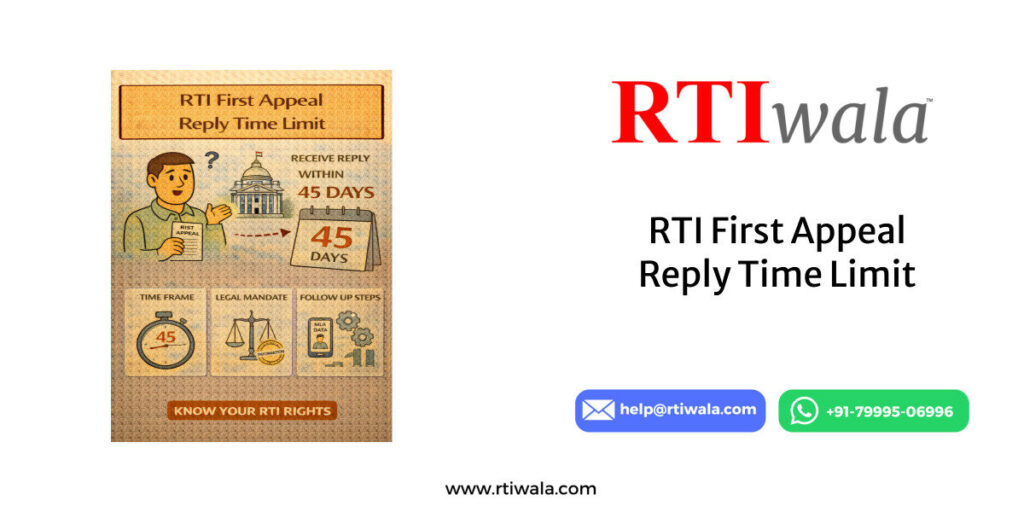
- The First Appellate Authority (FAA) must decide the appeal within 30 days of receiving it.
- In special circumstances, the FAA may take an additional 15 days, but only with a written justification.
Total maximum time = 45 days.
Fact: If you did not receive a reply within this time, the FAA is considered non-compliant, and you gain the right to escalate the matter to the Information Commission.
2. Verify Whether Your First Appeal Was Properly Submitted
Many appeals fail because:
- The wrong FAA was selected
- The appeal was emailed to a non-official ID
- The appeal was not acknowledged on the portal
- Speed post tracking shows delivered but the office denies receipt
Action: Keep the following ready as proof:
- RTI application & reply
- Copy of First Appeal
- Submission proof (portal receipt / speed post tracking / email timestamp)
These will be required when escalating to the Commission.
3. Identify Why the FAA Did Not Reply
From actual RTI cases across states, the common reasons include:
- FAA is overburdened (common in Revenue, Police, Urban bodies)
- PIO failed to forward the complete file to the FAA
- The department wants to avoid disclosures
- System/portal glitches (especially in state RTI portals)
- The FAA treats RTI as a low-priority task
Understanding the reason helps decide the next step—Second Appeal or Complaint.
4. If the Reply Was Poor or Irrelevant, Check for These Red Flags
Users often receive replies like:
- “Information not available.”
- “This does not pertain to us.”
- “Provide reasons for seeking information.”
- Copy-paste of RTI Act sections without answering anything.
- Only partial documents provided.
Fact: These are classic examples of malafide denial or vague replies, and the RTI Act provides strong remedies for this.
5. Your Next Legal Step: File a Second Appeal
If the FAA does not respond or sends a poor response, your remedy is to file a Second Appeal under Section 19(3) of the RTI Act with the respective Information Commission.
You must attach:
- Copy of RTI application
- PIO reply (if received)
- First Appeal copy
- Proof of submission
- Grounds of appeal (why you believe the reply is incomplete or no reply was given)
Fact: The Commission has the power to:
- Order the department to give full information
- Impose penalty on the PIO (₹250 per day up to ₹25,000)
- Recommend disciplinary action
- Direct inspection of records
- Summon the officer and ask for written justification
This step often compels the department to act quickly.
6. If the FAA Intentionally Ignored Your Appeal — File a Complaint Under Section 18
If you strongly feel the FAA acted deliberately, you may file a Complaint, which is legally more serious than a Second Appeal.
Reasons for filing a complaint include:
- No reply from FAA
- FAA refusing to accept the appeal
- PIO refusing information without reason
- False or misleading information given
- Deliberate obstruction
Fact: Many state commissions take complaints more seriously than appeals because they indicate misconduct.
What to Do If the First Appeal Reply Is Unsatisfactory
Sometimes the First Appellate Authority (FAA) sends a reply, but it feels incomplete, evasive, or does not address the actual questions you asked.
This situation is very common and happens due to:
- The FAA relying only on the PIO’s version without independent review
- Missing documents or vague responses
- Wrong exemptions being cited
- Partial or delayed information sharing
If your First Appeal reply is not satisfactory, you still have a strong legal remedy.
1. Compare the First Appeal reply with your original RTI
Check whether the FAA answered your specific information points or simply repeated the PIO’s reply.
This helps you assess exactly which parts are missing or incorrect.
2. Identify the gaps or excuses in the reply
Look for:
- Information avoided without proper reason
- Exemptions quoted without justification
- Documents not shared despite being available
- Mismatched or incomplete records
These gaps will form the basis of your Second Appeal.
3. File a Second Appeal before the Information Commission
If the reply is unsatisfactory, you can file a Second Appeal within 90 days of receiving it.
In the Second Appeal, you must clearly state:
- What information you requested
- What the PIO provided (or failed to provide)
- Why the FAA’s reply is inadequate
- What specific information is still required
The Information Commission will review the entire case and can direct the department to provide all pending documents.
What If Your RTI Second Appeal Is Not Answered? (Detailed Guide )
If your RTI Second Appeal has not been answered, don’t worry — your case is still active, but it is stuck in the Information Commission’s internal process.
Delays at this stage are extremely common due to the huge backlog of appeals across State and Central Information Commissions.
However, you must take timely steps; otherwise, your case may remain pending for several months or even years.
Below is a complete, step-by-step explanation based on real procedures followed by Information Commissions in India.
Why Second Appeals Are Often Not Answered
Backlog of appeals
Most Commissions have thousands of pending cases. Files get stuck in:
- Scrutiny stage
- Registration stage
- Listing stage (before being assigned to a Commissioner)
This is the most common reason.
Appeal not properly registered
If any mandatory document is missing, the Registry keeps the file on hold:
- Missing First Appeal copy
- Missing proof of First Appeal submission
- Missing RTI reply
- No annexures attached
The Commission will not inform you unless you follow up.
Wrong Commission or wrong public authority
If you filed the appeal before the:
- Wrong Commission
- Incorrect public authority
Your file may be marked as “Defective” and put aside until corrected.
Hearing not scheduled / communication not sent
Sometimes:
- Hearing date is allotted, but the notice isn’t delivered
- The file is pending allocation to a Commissioner
This delays the process without your knowledge.
Administrative delays
Internal issues like staff shortage, vacations, transfers, or manual file movement cause long delays.
What You Should Do Next If RTI Second Appeal Is Not Answered
These are the exact steps followed by legal professionals when an appeal is stuck:
Step 1: Check your appeal status online
Most Commissions have a status portal.
Search: “(Your State) Information Commission Case Status”
Look for:
- Case registration number
- Scrutiny status
- Whether objections were raised
- Whether hearing is scheduled
If no status appears, the appeal is likely not registered yet.
Step 2: Contact the Commission’s Registry
Call or email the Registry Section.
Ask:
- Is my Second Appeal registered?
- Has a case number been allotted?
- Has the file been sent to the Commissioner?
- Are any documents missing?
Registry officials are required to maintain case movement and usually respond when asked specifically.
Step 3: Send a formal “Reminder / Expedited Hearing Request”
A written representation asking for:
- Clarification of status
- Registration of appeal
- Early scheduling of hearing
- Action against delay
This creates an official trail and often pushes the file ahead.
Step 4: File a “Non-Compliance or Delay Petition”
If your RTI + First Appeal + Second Appeal all remain unanswered, you can file a short petition informing the Commission that:
- The department is violating RTI Act timelines
- The public authority is not cooperating
- Your appeal requires urgent listing
This is completely legal and often increases the case priority.
Step 5: Prepare your documents for the upcoming hearing
Before hearing, you must have:
- RTI Application
- First Appeal + proof of submission
- Second Appeal + annexures
- Department’s replies (if any)
- Evidence of delay
If any document is missing, the Commission may delay again.
How RTIwala’s Follow-Up Add-On Helps in This Situation
RTIwala’s Follow-Up Add-On is designed specifically for users facing delays at First Appeal or Second Appeal level.
Here’s how it helps you practically, step by step:
RTIwala’s Follow-Up Add-On tracks where your Second Appeal is stuck and identifies missing documents or delays.
It sends legally strong reminders and status inquiries to the Information Commission so your file starts moving.
It ensures continuous follow-up until your appeal gets registered, listed, and scheduled for hearing faster.
RTIwala Solutions for Unanswered RTI
RTIwala simplifies the process of dealing with unanswered RTIs. Here’s how we can help:
- Expert Guidance: Receive professional assistance in drafting and submitting first and second appeals.
- Tracking Service: Monitor the status of your RTI application and appeals to ensure timely follow-ups.
- Legal Support: Get support from legal experts to navigate complex situations and ensure your rights are upheld.
Why Choose RTIwala?
- Experienced Professionals: Our team has extensive experience in handling RTI applications and appeals.
- Affordable Solutions: We offer cost-effective solutions to ensure you get the information you need without breaking the bank.
- Comprehensive Support: From drafting applications to filing appeals, we provide end-to-end support.
FAQs
1. What should I do if my RTI is not answered within 30 days?
You should file a first appeal with the First Appellate Authority (FAA) within the same public authority. If you do not receive a satisfactory response, file a second appeal with the Central or State Information Commission.
2. How can I track the status of my RTI application?
You can track the status of your RTI application through RTIwala’s tracking service, which ensures you are updated on the progress of your request.
3. What if my first appeal is also not answered?
If your first appeal is not answered or the response is unsatisfactory, you can file a second appeal with the Central Information Commission (CIC) or the State Information Commission (SIC).
4. How can RTIwala assist me with my RTI appeal?
RTIwala provides expert guidance in drafting and submitting appeals, tracking the status of your application, and offering legal support to navigate the appeals process.
5. Is there a time limit for filing a second appeal?
Yes, you must file a second appeal within 90 days of receiving the decision on your first appeal.
Conclusion
Dealing with an unanswered RTI application can be frustrating, but it’s important to remember that you have the right to appeal and seek the information you requested. By following the steps outlined in this article and utilizing RTIwala’s expert services, you can navigate the process effectively and ensure your right to information is upheld.
Take Action Now!
Visit RTIwala today to get started on your RTI appeals. Our team is ready to assist you every step of the way, ensuring you get the information you need.